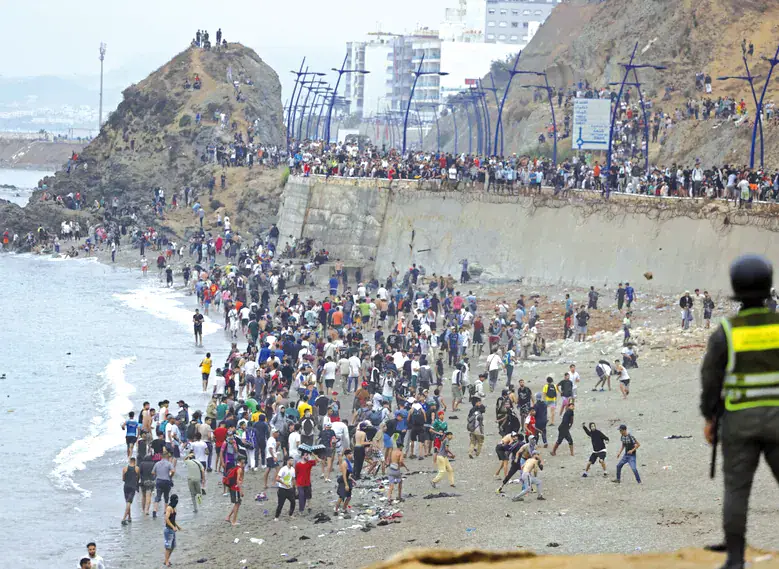
Spanish authorities have heightened security measures along the coastlines of Ceuta and Melilla, bracing for potential new waves of irregular migration from Morocco. This move comes after reports of attempted crossings by three boats, resulting in the detention of two individuals suspected of organizing irregular migration journeys. These actions are part of a broader effort to prevent a repeat of the mass migration incidents that occurred on July 30 and 31, when tens of thousands of irregular migrants from Morocco entered Ceuta.
The recent incidents involved the interception of three boats by Spain's maritime service, which led to the arrest of two suspected traffickers. One of the boats, a "phantom" type, was carrying over 20 Moroccan migrants when it was intercepted. In another instance, the boat's engine failed, prompting the driver to abandon ship and swim to shore, leaving the migrants adrift. These events highlight the ongoing challenges of irregular migration in the region and the risks faced by migrants attempting to cross into Spain.
In response to these developments, Spanish authorities have mobilized military units to support border control and security efforts. Over 100,000 security personnel have been deployed nationwide for the general elections, an 11.5% increase from the previous elections in July 2023. This enhanced security presence aims to deter and manage potential large-scale attempts to cross the border. The measures are part of a national security plan announced by the Spanish Interior Ministry.
The security concerns are compounded by the political tensions between Spain and Morocco, with migration being a significant point of contention. The autonomous cities of Ceuta and Melilla, located on the Moroccan border, have been particularly affected by the migration issue. The cities' leaders have called for a specific strategy to address their unique challenges, including enhanced security and development support.
Juan Vivas, the president of the Ceuta government, recently visited Melilla to discuss the shared challenges faced by both cities. He emphasized the need for a tailored state strategy to address security, stability, and development concerns in both Ceuta and Melilla. Vivas noted that four months after the mass migration incidents, Ceuta has yet to return to normalcy and stressed the importance of a proportionate political and institutional response to the crisis.
The situation in Ceuta and Melilla remains volatile, with ongoing concerns about irregular migration and its impact on local communities. The Spanish government's response aims to balance security measures with the need for a comprehensive approach to address the root causes of migration. The situation continues to be a priority for both Spanish and Moroccan authorities, given its implications for regional stability and bilateral relations.
The recent security measures and incidents underscore the complexities of managing irregular migration in the region. Efforts to enhance border control and security are ongoing, with cooperation between Spanish and Moroccan authorities being crucial in addressing the challenges posed by irregular migration. The situation in Ceuta and Melilla remains a critical issue for both countries, requiring sustained attention and coordinated action.
Key points
- Spain has raised its alert level on Ceuta and Melilla coasts amid concerns of new migration waves from Morocco.
- Over 100,000 security personnel have been deployed nationwide for the general elections, an 11.5% increase from the previous elections.
- Local leaders are calling for a specific strategy to address the unique challenges faced by Ceuta and Melilla, including enhanced security and development support.
Reporting sources
- استنفـار أمنـي بسواحل سبتـة ومليليـــة · Ech-Chaab