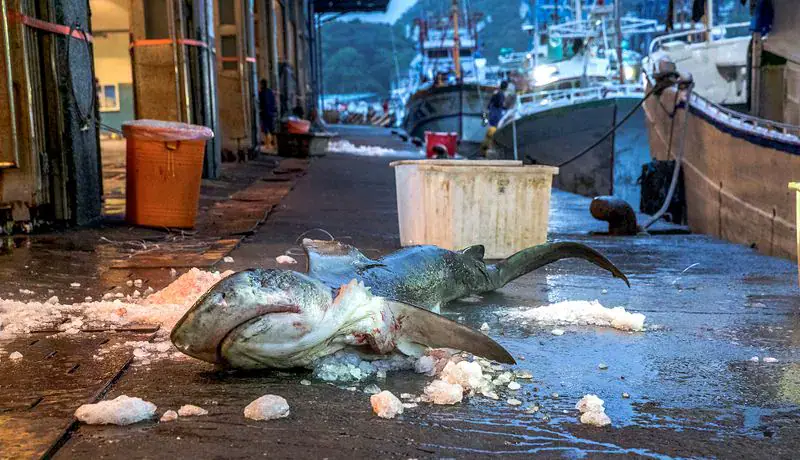
Industrial fishing has made Spain and Taiwan the world's biggest blue shark catchers, with a combined total of 77,265.3 tonnes caught in 2024. The blue shark fishery has become a significant industry, with companies like Hermanos Fernández Ibáñez in Spain processing large quantities of blue sharks. The company's factory in Vigo processes blue sharks caught in the Atlantic, Pacific, and Indian oceans, with the meat sold in European supermarkets and the fins and skins exported to Asia. Claudio Ibáñez, in charge of the factory, explains that the business model is straightforward: catch the sharks and sell the meat and fins.
The blue shark fishery has become a crucial complement to the swordfish fishery for companies like Hermanos Fernández Ibáñez. Ibáñez explains that the company started fishing swordfish 35 years ago and began catching blue sharks in significant quantities 15 years ago. The blue shark fishery is now a vital part of the company's operations, with the sharks caught on long lines with the same hooks as swordfish. The boats stay out in the oceans for years, and the crews are flown back to Spain for rotation. The landed sharks are shipped to the processing plant in containers.
Blue sharks are a pelagic species found across the world's oceans and are one of the most abundant shark species. They have a varied diet, with cephalopods like squid and octopus being an important food source. Blue sharks are also one of the most fecund species of shark, with females having litters of 34 pups on average and reproducing annually. However, their reproduction rate is slower than that of bony fish, which are struggling to compensate for overfishing. According to FishStat, a database belonging to the Food and Agriculture Organization of the United Nations (FAO), 119,820.62 tonnes of blue sharks were caught in 2024.
Spain and Taiwan dominate the global blue shark catch, with Spain catching 45,374.92 tonnes (37.8% of the global catch) and Taiwan 31,890.38 tonnes (26.6%) in 2024. Other countries like Peru and Namibia play important transit roles, with Walvis Bay in Namibia being an important port for Spanish fishing companies to land and process blue sharks. In 2024, Spain imported 1,725.35 tonnes of blue shark with a value of R30-million from Namibia. The FAO's total catch figures are heavily reliant on records from industrial fishing fleets, which may not accurately reflect the actual level of fishing.
The actual level of blue shark fishing is likely much higher than reported. A study by Sea Around Us concluded that a total of 347,229.31 tonnes of blue shark were caught in 2019, considerably higher than the FAO's figure of 109,982.24 tonnes. Another study by Hoang Huy Huynh of the National Kaohsiung University of Science and Technology in Taiwan estimated that actual catches in the Indian Ocean are likely to exceed 55,000 tons due to inadequate monitoring, misreporting, and illegal, unreported, and unregulated (IUU) fishing.
The blue shark fishery has expanded rapidly in recent decades. In 1950, only one country, Indonesia, reported landing blue sharks, with a catch of 47 tonnes. It wasn't until 1978 that France landed four tonnes, and Spain started fishing blue sharks in 1997, landing 29,917 tonnes. Taiwan's reported catch came a decade later, with a haul of 3,399 tonnes. The rapid expansion of the fishery has raised concerns about overfishing and the impact on blue shark populations.
The value of the blue shark fishery is substantial, with an estimated 4.4 million blue sharks caught in 2024, based on the FAO's catch figure. Using an estimated average weight of 27kg per shark landed, the 2019 value of blue shark meat and fins was estimated to be R6.6-billion. The industry's reliance on combining blue shark and swordfish fisheries raises questions about the long-term sustainability of the fishery and the need for more effective management and conservation measures.
Key points
- The blue shark fishery is driven by industrial fishing fleets, with Spain and Taiwan dominating the global catch.
- Flawed science and inadequate monitoring contribute to overfishing and underreporting of blue shark catches.
- The blue shark fishery's rapid expansion raises concerns about the impact on blue shark populations and the need for more effective management and conservation measures.