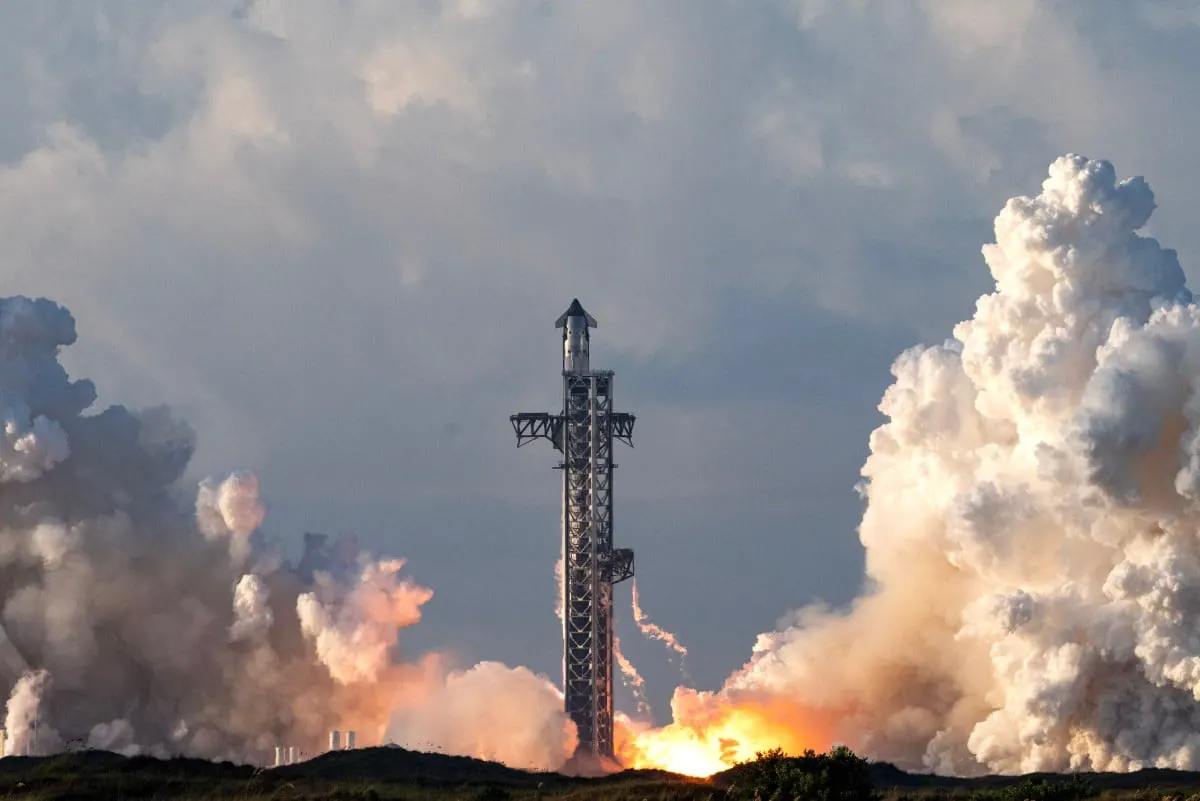
In a significant achievement, Elon Musk's SpaceX launched its Starship megarocket into orbit for the first time on Monday. The rocket, standing over 120 meters tall, blasted off from Texas and completed its 14th test flight. The upper stage of the rocket separated from the Super Heavy booster and reached orbit approximately 26 minutes into the flight. This test marks a crucial step towards SpaceX's ambitious plans for trips to the Moon and Mars.
The Starship megarocket, a black-and-silver behemoth, rose through a thick cloud of smoke during its launch. The experimental rocket's upper stage was set to orbit Earth several times and deploy 26 next-generation Starlink satellites. As a precaution, the spacecraft was launched on a suborbital trajectory, and the launch team decided to perform a second burn to reach orbit. This maneuver required precise calculations and significant forces, making it a challenging part of the test.
The successful launch of Starship into orbit is a major milestone for SpaceX, which began flying the rocket in its full configuration in 2023. The company has made numerous modifications to the rocket through successive tests, with some ending in spectacular explosions. Despite the challenges, SpaceX hopes to usher in an "exciting new phase" of development, including tests of refueling the rocket in orbit. This will be crucial for the rocket's reusability and future commercial flights.
To reach the necessary altitude and speed, the rocket had to perform complex calculations and withstand different levels of gravity. According to Kathleen Curlee, a senior analyst at Georgetown University's Center for Security and Emerging Technology, the second burn to reach orbit was "the hardest part" of the test. The rocket achieved a speed of approximately 28,000 km/hour and a circular orbit about 275 km above the Earth.
Once in orbit, the spacecraft began deploying next-generation Starlink satellites designed to expand SpaceX's massive satellite internet constellation. The plan calls for the rocket to finish its journey in the Pacific Ocean after orbiting the Earth six times. The huge first-stage booster, called "Super Heavy," fell into the Gulf of Mexico shortly after launch. This test flight aims to accelerate the development of the largest and most powerful rocket ever designed.
From an engineering perspective, achieving flight and gathering data would be considered a success. However, spectators and investors have higher expectations, and anything less would be seen as a failure. The development of Starship has faced repeated delays, and a Chinese company has recently made progress in the field of reusable rockets. SpaceX must continue to overcome technical challenges to make Starship fully reusable and conduct commercial flights.
The successful launch of Starship into orbit marks a significant step towards SpaceX's ambitious plans for space exploration. The company aims to deploy data centers in orbit, reach the Moon, and eventually send missions to Mars. With this new test, SpaceX hopes to pave the way for future developments and make Starship a crucial part of its space exploration endeavors. The company's progress will be closely watched by spectators, investors, and the space industry as a whole.
Key points
- SpaceX's Starship megarocket successfully reached orbit for the first time, marking a major milestone in the company's plans for lunar and Mars missions.
- The rocket achieved a speed of approximately 28,000 km/hour and a circular orbit about 275 km above the Earth.
- The successful launch of Starship into orbit paves the way for future developments, including tests of refueling the rocket in orbit and deploying data centers in space.