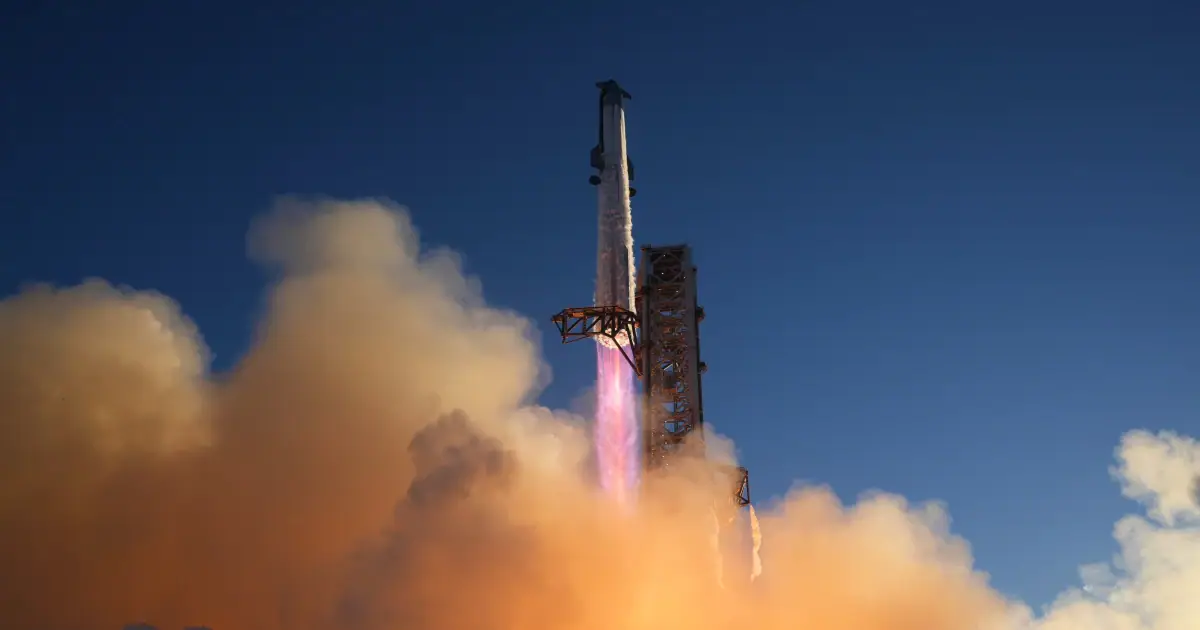
SpaceX's Starship spacecraft successfully completed a historic capture on Saturday, being caught in midair by giant mechanical arms at the launch pad 22 hours after its journey began. The spacecraft had traveled to space and completed 14 laps around Earth, outshining the previous mission's one to two laps. The live views of itself and Earth were streamed down via Starlink, showcasing the spacecraft's capabilities. This achievement marks a significant milestone for SpaceX and its reusable spacecraft technology.
The Starship spacecraft was launched on Friday from SpaceX's Starship base near the U.S.-Mexican border, blasting off into space as the world's largest and most powerful rocket, a 407-foot behemoth. However, the first-stage booster exploded shortly after liftoff, resulting in wreckage remaining in the Gulf of Mexico. Despite this setback, SpaceX officials stated that Saturday's catch demonstrates the full reusability of Starship, which is intended for moon and Mars travel.
The successful capture of Starship has garnered attention from NASA, which is paying billions of dollars for Starship to land Artemis astronauts on the moon later this decade and help build a permanent lunar base. NASA welcomed Saturday's news, recognizing the significance of this achievement for future space exploration. SpaceX's advancements in reusable spacecraft technology are crucial for the development of sustainable space travel.
Elon Musk's ambitions for Starship extend beyond lunar missions, with plans to launch a fleet of Starships to build a city on Mars. The spacecraft's capabilities were showcased during its 15th flight of a full-scale Starship since 2023, and its second trip to orbit. The mission demonstrated that everything on the spacecraft, including its vital heat shield, appeared to work well.
Engineers are still investigating the cause of the booster explosion, which occurred when its engines stopped firing too soon on the way back down. The booster's guidance system sensed it wasn't in the right position and automatically initiated a watery detour and self-destruction. Despite this setback, SpaceX expects to begin launching Starships from Florida's Kennedy Space Center within the next few months.
The upcoming launch from Kennedy Space Center will mark the starting point for NASA's next Artemis mission, which will skip the moon and remain in orbit around Earth for lunar lander practice. Artemis III's four astronauts will attempt to dock their capsule with not only Starship but Blue Origin's Blue Moon. The two companies will take turns delivering crews to the lunar surface.
NASA is targeting as soon as 2028 for Artemis IV, humanity's first moon landing since the Apollo era more than half a century ago. SpaceX's advancements in reusable spacecraft technology will play a crucial role in achieving this goal. The company's continued innovation and testing will be essential for the development of sustainable space travel and exploration.
Key points
- SpaceX's Starship successfully completed a historic capture in midair, marking the first-ever capture of a Starship flying back from space.
- The achievement demonstrates the full reusability of Starship, which is intended for moon and Mars travel.
- NASA welcomed the achievement, recognizing its significance for future space exploration and the development of sustainable space travel.