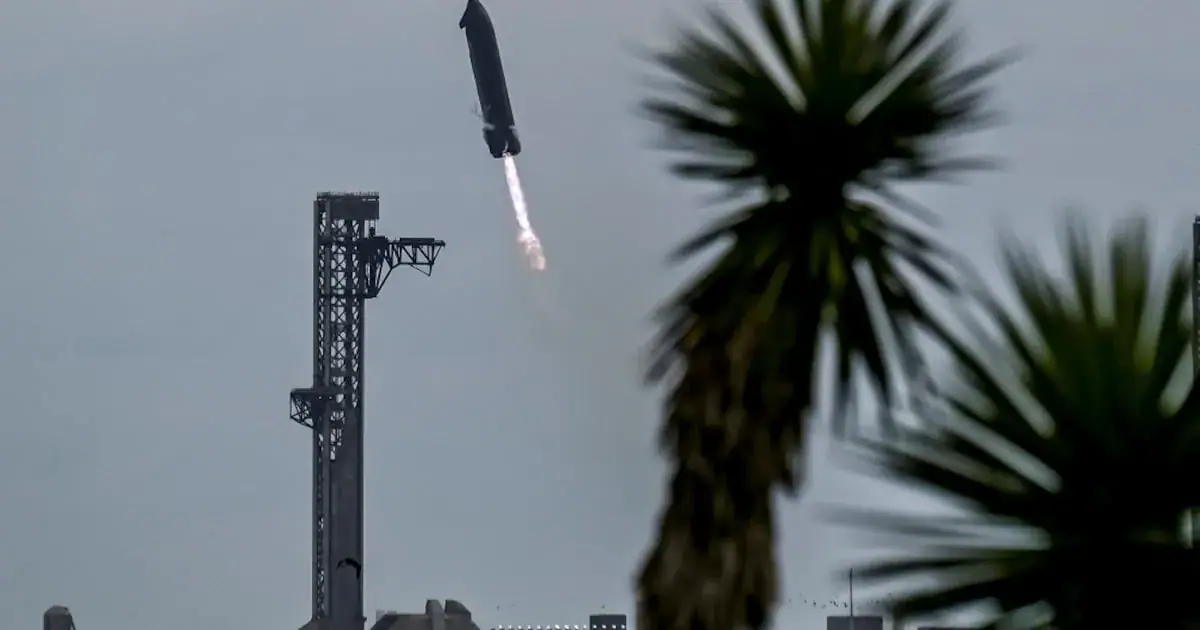
SpaceX's Starship spacecraft completed a 22-hour voyage in orbit and successfully descended into the grasp of giant mechanical arms at the Texas tower on Saturday. The 52m Starship fell out of thick clouds over SpaceX's Starbase launch site, reignited engines to flip itself vertical, and slowly descended into the tower's "Mechazilla" arms, engines still roaring. Charred from the blazing heat of its return from space, the ship shut down its engines and hung still after the rocket system's longest mission yet.
The successful catch marked a key engineering milestone in the development of Starship, which billionaire Elon Musk sees as the future workhorse for SpaceX's lucrative Starlink satellite business and ambitions to put data centres in orbit, return humans to the moon, and settle on Mars. Starship's return came after deploying 26 Starlink satellites in orbit on Friday night while cruising about 260km in altitude. The spacecraft then fired one of its engines to begin an atmospheric plunge while flying eastward over the Pacific Ocean.
During its return, Starship faced blistering heat as its orbital speed of 17,000 miles per hour slowed to a supersonic free-fall in the skies above SpaceX's Starbase facilities on the Gulf Coast of south Texas. With its aerodynamic fins folded back, two small fittings near the top of Starship hooked onto the launch tower's mechanical arms that had closed in to grasp it, allowing the vessel to hang a few hundred metres off the ground.
Musk and SpaceX engineers began inspecting the ship within hours of its catch, with Musk writing on X that "Ship 42 looks great!" The successful recovery advances rocket reusability, a key goal for SpaceX. The company's dominance in the global launch industry is centred on its workhorse Falcon 9 rocket, which has launched over 700 times since 2010.
However, the Falcon 9's second stage is discarded into the ocean after each flight, whereas Starship aims to be fully reusable. SpaceX has yet to recover both Starship stages in a single mission, which would mark the first-ever return of an orbital launch system. The company is working to engineer new tile designs for Starship's heat shield, which will require little to no refurbishment after each mission.
SpaceX has spent more than $15bn on Starship's development, with Nasa providing $3.2bn as part of a contract valued at more than $4bn to return humans to the moon using Starship under the space agency's Artemis programme. Nasa expects Starship to start crewed flights to the moon in 2028, though several challenging development milestones remain.
Those milestones include demonstrating complex fuel transfers between Starship tanker rockets in orbit, a critical process that will enable the ship to travel beyond Earth's orbit to the moon. The successful catch of Starship marks a significant step towards achieving these goals, with SpaceX continuing to push the boundaries of rocket reusability and space exploration.
Key points
- SpaceX's Starship spacecraft successfully descended into giant mechanical arms at the Texas tower after a 22-hour voyage in orbit.
- The successful catch marked a key engineering milestone in the development of Starship, which aims to be fully reusable.
- SpaceX has spent more than $15bn on Starship's development, with Nasa providing $3.2bn as part of a contract to return humans to the moon.
Reporting sources
- WATCH | SpaceX Starship successfully caught in tower arms · The Rand Daily Mail