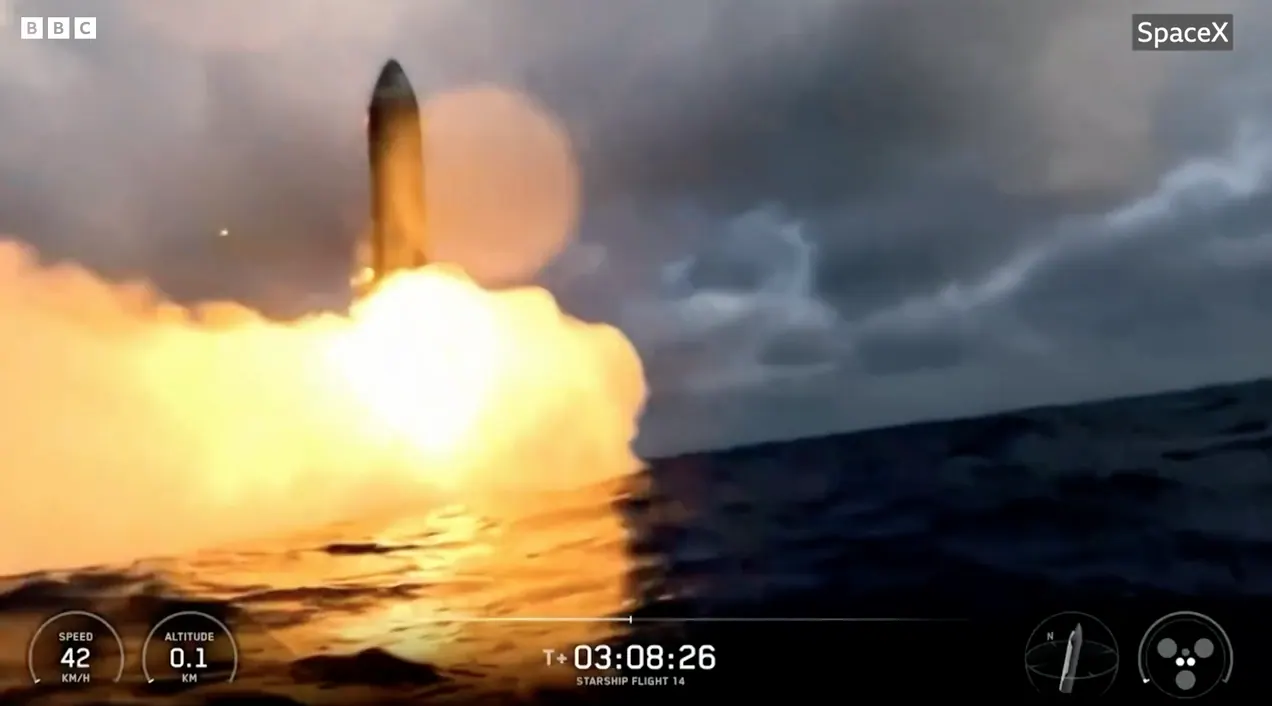
SpaceX's Starship spacecraft has successfully completed its first orbital flight around Earth, splashing down in the Pacific Ocean on Monday, September 28. The spacecraft spent about three hours in orbit before returning to Earth, instead of the planned 10-hour mission. This marked a significant milestone for SpaceX, as Starship reached Earth's orbit for the first time. The mission was the 14th launch of SpaceX's Starship rocket, described as the most powerful launch vehicle ever developed.
The Starship spacecraft completed two laps of the planet before the company decided to bring it back early. During the mission, 26 next-generation Starlink V3 satellites were successfully deployed into low Earth orbit. These satellites are designed to increase the capacity and user speeds of SpaceX's existing broadband network. They will establish connections with the ground and other satellites through radio and laser links. The deployment of these satellites was a significant achievement for SpaceX.
However, the flight was not without difficulties. Before entering orbit, engineers faced an issue with one of the spacecraft's six engines. This prompted discussions over whether the mission should proceed, but the team eventually gave the spacecraft clearance to continue into orbit. SpaceX later decided to shorten the mission, reducing the planned six orbits to two. The company has not yet explained why the flight was terminated early.
The spacecraft began its return journey, performing a de-orbit burn before entering Earth's atmosphere. Starship eventually splashed down in the Pacific Ocean, accompanied by a large fireball. The spacecraft was later seen floating on its side in the ocean. The booster, meanwhile, completed its own landing in the Gulf of Mexico. Unlike some previous Starship tests, neither the booster nor the spacecraft is expected to be recovered for reuse from this mission.
SpaceX has previously demonstrated its ability to catch returning boosters using giant mechanical arms. However, the Starship spacecraft landed in the Pacific and appeared to have suffered significant damage during the splashdown. Despite the shortened mission, experts believe SpaceX was likely pleased with the outcome because the main objective of reaching orbit had been achieved.
The mission marked a significant step towards SpaceX's goal of making Starship reusable and eventually using it to transport crew and cargo to Earth orbit and the Moon. SpaceX intends to use Starship for future missions, including crewed missions to the Moon and beyond. The successful deployment of the Starlink satellites will also enhance SpaceX's broadband network.
According to BBC science reporter Georgina Rannard, SpaceX was likely to be pleased with the outcome of the mission. The company achieved its main objective of reaching orbit, despite the early return. The mission demonstrated the capabilities of the Starship spacecraft and paved the way for future missions. SpaceX will likely continue to test and refine the Starship spacecraft in the coming months.
Key points
- SpaceX's Starship spacecraft completes first orbital flight with early return.
- The mission deployed 26 next-generation Starlink V3 satellites into low Earth orbit.
- The spacecraft splashed down in the Pacific Ocean, accompanied by a large fireball.