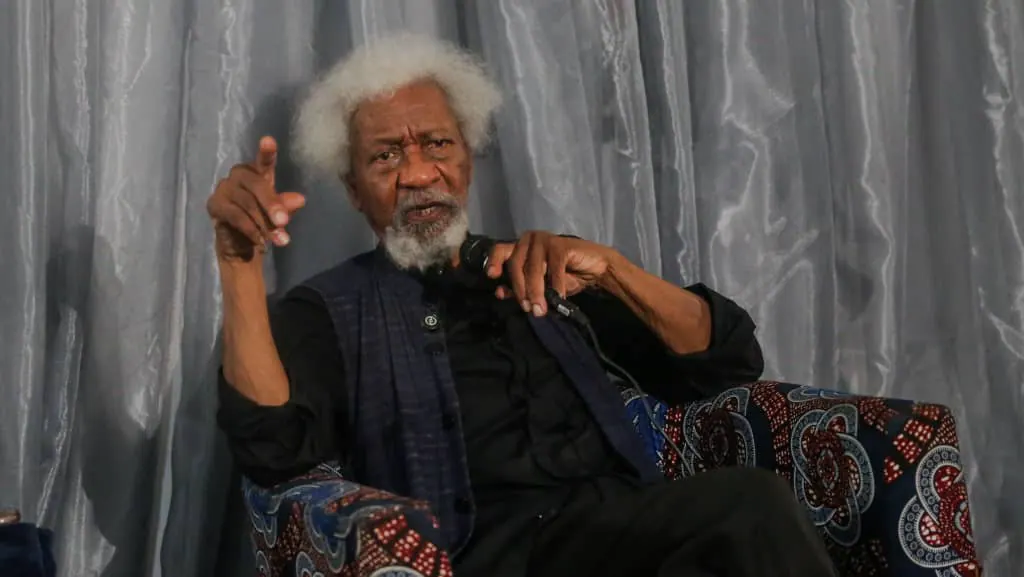
Nobel laureate Professor Wole Soyinka has warned that the growing influence of artificial intelligence (AI) poses a real threat to human creativity. He made this statement at the NLNG Grand Award Night held on Friday, October 9, at Eko Hotel and Suites, Lagos. Soyinka stressed that the objective should not be to halt technological advancement but to ensure that it does not diminish human creativity. He emphasized the need for society to establish boundaries to prevent machines from taking over the imaginative and intellectual capacities of human beings.
Soyinka acknowledged the potential of artificial intelligence as a facilitator of human progress. However, he raised serious concerns about its growing capacity to perform tasks traditionally associated with human creativity. He warned that allowing machines to write poetry, academic theses, and other creative works on behalf of human beings could gradually undermine the human imagination and lead to the dehumanisation of society. Soyinka noted that when artificial intelligence begins to write thesis, poetry, or claims to write poetry for humans, there is danger.
The Nobel laureate cautioned that the threat could extend beyond machines assisting humans with routine tasks to the emergence of artificial replicas of writers and other creative personalities that could imitate their styles, mannerisms, and gestures. Soyinka warned that when a clone of a writer or a prize winner emerges on the internet, masquerading and imitating gestures thought to be exclusive to human beings, then there is a real problem. He urged a synthesis between technological development and the philosophy of creativity.
Soyinka insisted that machines should complement, rather than replace, human beings. He stated that machines cannot create for humans, but can measure. Soyinka called for a balance between technological advancement and human creativity, emphasizing that imagination is indispensable to scientific inquiry and technological innovation. He noted that scientists and technologists also need imagination to interpret facts, develop ideas, and undertake complex calculations.
The Nobel laureate urged the Nigerian Liquefied Natural Gas (NLNG) Limited to consider introducing a special consolation prize in anticipation of the challenges artificial intelligence could pose to creative professionals. He explained that such a measure could help address concerns about the possibility of AI depriving writers and other creative practitioners of their livelihoods. Soyinka's warning came as he urged the sciences and the humanities to work together.
Soyinka described the introduction of the new discipline of transfigural mathematics as an opportunity to expand the boundaries of imagination and encourage greater collaboration between the humanities and the sciences. He urged members of both fields to appreciate their interdependence and work towards building a society in which different disciplines could retain their distinctive identities while benefiting from one another.
Concluding his address, Soyinka delivered a message that underscored his concerns about the future of humanity in an increasingly technology-driven world. He congratulated the eventual winners of the evening's awards and encouraged them not to abandon their interest in science, noting that the willingness to imagine the impossible is essential to scientific progress. Soyinka's message was clear: "My plea to you tonight is: please humanise machines, not let machines machinise humanity."
Key points
- Soyinka warns that AI poses a real threat to human creativity.
- Soyinka urges a synthesis between technological development and the philosophy of creativity.
- Soyinka emphasizes the need for society to establish boundaries to prevent machines from taking over human imaginative and intellectual capacities.