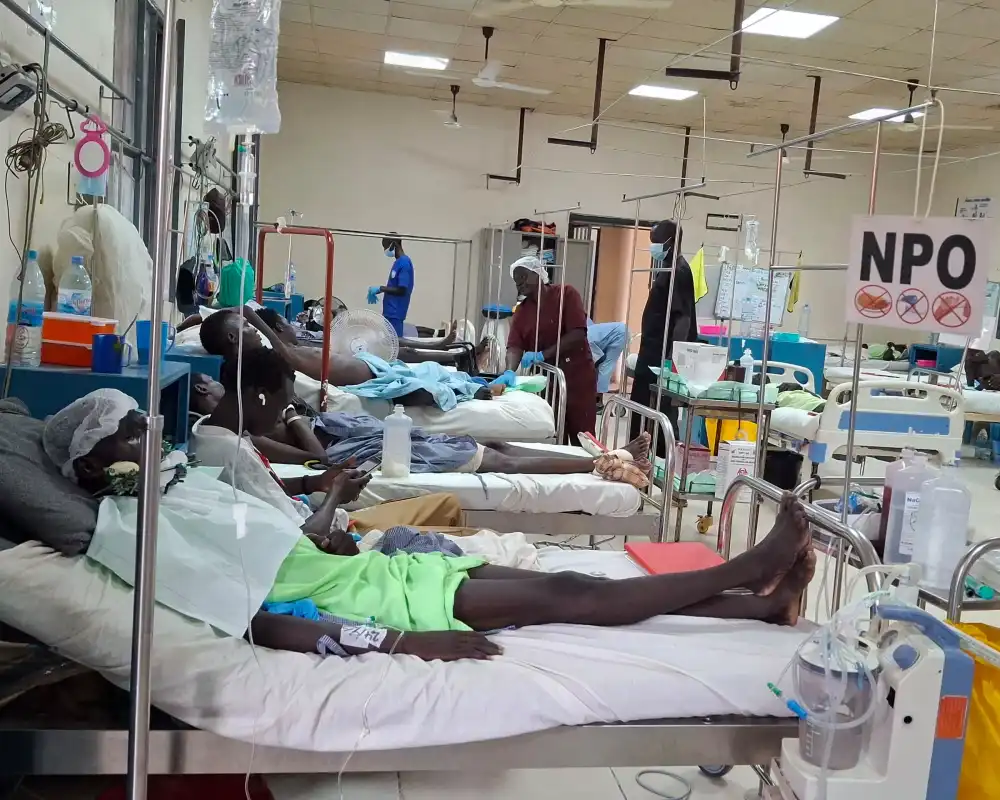
Dr. Slobodan Mirosavljev, a surgeon at Juba military hospital in South Sudan, has grown accustomed to uncertainty. By 11am on a recent Thursday, he had already treated two critically wounded patients. The day was far from over, but Mirosavljev couldn't predict how long he would be at the facility. Patients with gunshot wounds to the abdomen, head, or chest could arrive at any moment. Helicopters might bring multiple critically injured individuals from other parts of the country.
The hospital, supported by the International Committee of the Red Cross (ICRC), is struggling to cope with the increased demand for surgical care due to renewed fighting between the South Sudan People's Defence Forces (SSPDF) and the Sudan People's Liberation Movement-In Opposition (SPLM-IO). The conflict, which has intensified over the past year, particularly in Jonglei state, has put a strain on the already fragile and under-resourced health system in the world's youngest country.
The renewed conflict is rooted in a long-standing political crisis fueled by President Salva Kiir sidelining former Vice-President Riek Machar. The two leaders were once members of the Sudan People's Liberation Army, a guerrilla movement that fought for independence from Sudan. South Sudan gained independence in 2011, with Kiir becoming president and Machar the first vice-president. However, their relationship deteriorated, and the country descended into a bloody civil war in 2013.
The civil war, which lasted for years, resulted in over 400,000 deaths and displaced nearly half of the country's population. The conflict was largely fought along ethnic lines, pitting Kiir's majority Dinka community against Machar's Nuer, the second-largest ethnic group. A peace deal was signed in 2018, ending the civil war and creating a unity government. However, the implementation of the agreement has stalled due to ongoing power struggles between the two parties.
The current escalation of violence was triggered by a deadly attack by the White Army, a rebel group allied to Machar, on a government garrison in Nasir county in Upper Nile state in March 2025. The attack led to Machar being charged with murder, treason, and other serious crimes. Kiir subsequently suspended him from his post, further inflaming tensions in the country. Machar's supporters argue that the charges are politically motivated, while observers warn that they risk jeopardizing the peace agreement.
The renewed violence has significant implications for South Sudan, where elections are scheduled for December. The country's health system, already struggling to cope with the aftermath of the civil war, is now facing an increased burden. The ICRC and other humanitarian organizations are working to provide medical care to those affected by the conflict. However, the situation remains precarious, with the potential for further escalation.
The humanitarian situation in South Sudan is dire, with many civilians bearing the brunt of the renewed violence. The international community is closely monitoring the situation, with some countries calling for restraint and a return to the negotiating table. The road to peace and stability in South Sudan remains long and uncertain, with the country's leaders facing significant challenges in restoring trust and rebuilding the nation.
Key points
- The conflict in South Sudan has resulted in a significant increase in demand for surgical care, overwhelming the country's already fragile health system.
- The renewed violence has its roots in a long-standing political crisis fueled by President Salva Kiir sidelining former Vice-President Riek Machar.
- The international community is closely monitoring the situation, with some countries calling for restraint and a return to the negotiating table.