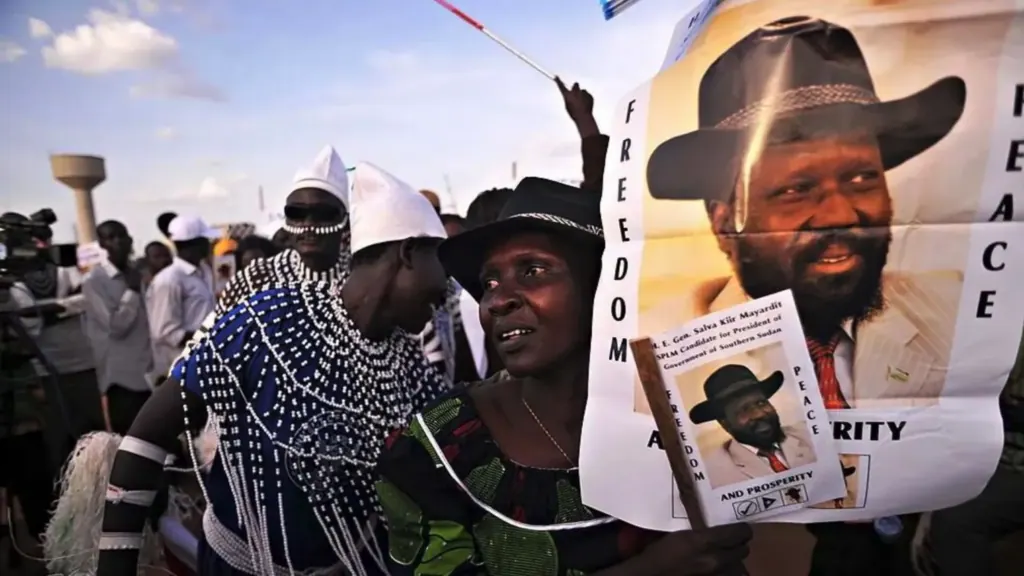
South Sudan President Salva Kiir has dissolved the transitional government, three months before the country's first election since its independence in 2011. This move comes after several postponements of elections and extensions of the transitional period. The amended law, signed on Monday, led to the removal of the country's five vice-presidents and the dissolution of parliament, as well as national and state governments.
Kiir, who is the presidential candidate of his Sudan People's Liberation Movement (SPLM), will remain in office with full constitutional powers until an elected president is sworn in. He reappointed some ministers and governors in caretaker positions until the 22 December elections. This development has raised concerns about the country's preparedness for the upcoming elections.
A heavy security presence was reported in the capital, Juba, ahead of Tuesday's announcement. Soldiers from the army and national security services blocked access to government ministries, and soldiers were seen patrolling parts of the city. A senior government official told the BBC that staff arriving for work were turned away and told to return the following Monday.
The main opposition leader, Riek Machar, was sacked as vice-president last year and charged with treason. He is currently under house arrest. Machar had been named vice-president as part of a 2018 peace deal to end a five-year civil war between forces loyal to Kiir and Machar. No prominent figures have announced plans to challenge Kiir in the December poll.
The chairman of the national elections commission, Abednego Akok Kacuol, was dismissed by Kiir last week without a reason. He was replaced by the commission's secretary-general, Gabriel Bol Deng. Akok had previously stated that the commission needed $250m to conduct the election but had received only $21m.
The Reconstituted Joint Monitoring and Evaluation Commission (RJMEC), which oversees the implementation of the 2018 peace agreement, said South Sudan had entered a "critical phase". The commission urged the parties to agree on a path towards credible elections and a peaceful end to the transitional period, which has lasted since independence.
The Sudan People's Liberation Movement in Opposition (SPLM-IO), Machar's party, had warned people not to take part in poll preparations in June. The group's acting chairperson, Nathaniel Pierino, stated that anyone coming to register voters and campaign in territories controlled by the SPLM-IO would be considered a prisoner of war.
Key points
- President Salva Kiir dissolved the transitional government ahead of South Sudan's first elections since independence in 2011.
- The country's main opposition leader, Riek Machar, is under house arrest and faces treason charges.
- The elections commission faces a significant funding gap, having received only $21m of the required $250m.