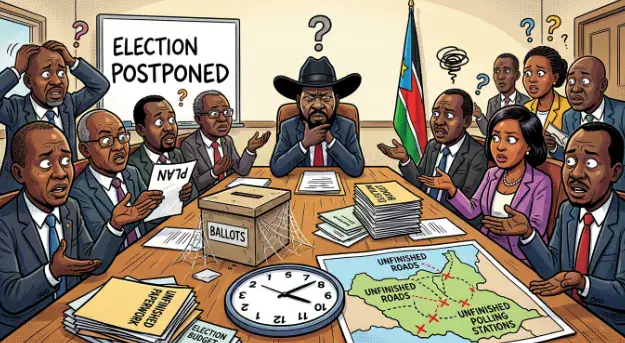
The National Elections Commission's decision to move polling day has raised questions about South Sudan's transition. The commission cited Article 57(1)(c) of the National Elections Act 2012, as amended, as the basis for revising the timetable. This move has added 51 days to the electoral calendar, but its timing and institutional context have sparked concerns. The national and state legislative bodies have been dissolved, and a caretaker administration has been appointed pending the completion of the elections.
The postponement has raised questions about its relationship with the deadline set in the wider legal framework. The revised calendar places polling day on February 11, 2027, just 11 days before the transitional period is due to end on February 22. This narrow window may cause issues with the announcement of results and the resolution of election petitions. The authorities have been urged to publish the full legal basis for the decision and explain how the Elections Act, the Transitional Constitution, and the peace agreement are being reconciled.
There are five possible scenarios for the future of the transitional government. The first scenario is that elections will be held on February 11, 2027, and there will be an orderly political transition. However, this requires more than just keeping the announced date, including voter registration, publication of the final register, candidate nominations, and appeals. The second scenario is a further technical postponement due to preparations falling behind, which could be caused by inadequate funding, limited technical capacity, or problems with registration.
A further postponement could lead to a recurring pattern, weakening public, political, and international confidence. If another postponement becomes unavoidable, it should be publicly justified, limited to a clearly defined period, supported by a published financing plan and measurable milestones, and subject to independent scrutiny. The third scenario is partial or incomplete elections, which could produce geographically or institutionally uneven results and disputes over representation.
The fourth scenario is a prolonged deadlock and the normalization of the status quo, which could lead to caretaker arrangements continuing without a reliable time limit, parliament remaining absent, and public accountability weakening. This scenario could erode confidence in state institutions, the electoral process, and the country's transition to elected institutions. The fifth scenario is not mentioned in the article.
The National Elections Commission's decision has sparked concerns about the country's transition to elected institutions. The commission's revision of polling day has raised questions about its relationship with the deadline set in the wider legal framework. The authorities have been urged to publish the full legal basis for the decision and explain how the Elections Act, the Transitional Constitution, and the peace agreement are being reconciled.
The postponement of polling day has significant implications for South Sudan's transition. The country's transition to elected institutions is dependent on credible general elections being held and the results being accepted through lawful procedures. The international community is watching closely, and the country's future is uncertain.
Key points
- The National Elections Commission has postponed polling day from December 22, 2026, to February 11, 2027.
- There are five possible scenarios for the future of the transitional government, including an orderly political transition, a further technical postponement, partial or incomplete elections, a prolonged deadlock, and more.
- The postponement has raised concerns about the country's transition to elected institutions and the potential for a prolonged deadlock.