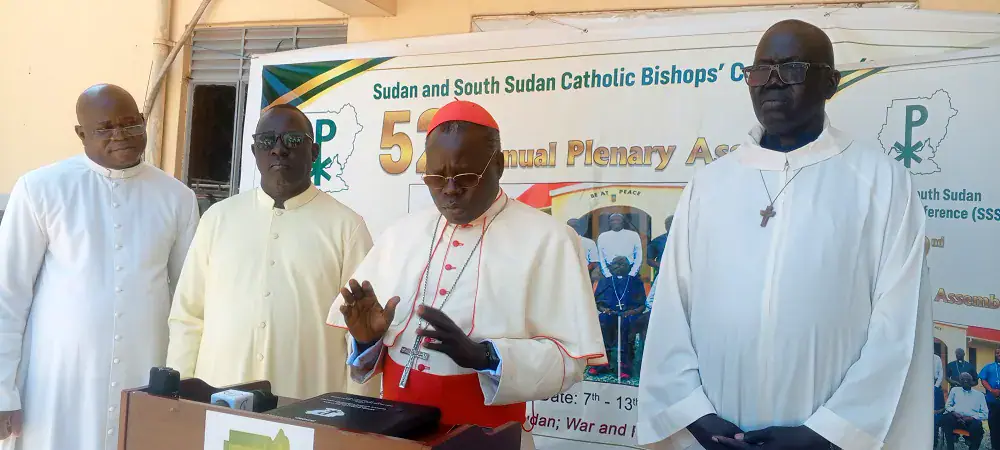
The Catholic Bishops of Sudan and South Sudan have urged the caretaker government to operate within constitutional and legal limits, warning that the arrangement must not become an instrument for arbitrary power or political exclusion. The bishops, led by Cardinal Stephen Ameyu Mulla, Archbishop of the Catholic Archdiocese of Juba, made the call in a communiqué at the conclusion of their 52nd Annual Plenary Assembly in Torit, held from November 7 to 13.
The bishops emphasized that the caretaker government must have a clearly defined legal mandate and limits as the country prepares for general elections scheduled for February 11, 2027. They said the arrangement must safeguard national stability, maintain essential public services, protect citizens' rights, and facilitate peaceful and credible democratic transition. The church leaders stressed that all political and administrative arrangements exercising public authority must be guided by the Transitional Constitution, the 2018 Revitalized Agreement on the Resolution of the Conflict in South Sudan, and relevant laws.
The bishops' concerns come nearly two months after President Salva Kiir dissolved the Revitalized Transitional Government of National Unity and replaced it with a caretaker government. This move followed amendments to the National Elections Act, retaining President Kiir's constitutional powers until a new government is sworn in. The legal basis of the caretaker arrangement has drawn criticism from commentators, who argue that an ordinary law cannot create a government structure or powers not provided for under the Transitional Constitution.
The Catholic Church has expressed concerns about the country's readiness to hold elections, citing inadequate institutional, technical, financial, and security preparations, as well as incomplete transitional tasks, political mistrust, insecurity, and displacement. The bishops urged the caretaker government, the National Election Commission, political parties, and other stakeholders to ensure the process is inclusive, transparent, peaceful, and credible.
The church leaders called on the National Election Commission to operate independently and impartially, with adequate resources and without political interference. They also urged dialogue between the government, opposition parties, and groups that did not sign the 2018 peace agreement, warning that no lasting peace can be built through exclusion or unilateral decisions.
The Catholic Church reaffirmed its willingness to support efforts towards peace and reconciliation in South Sudan, saying it is ready to accompany the leaders, the international community, and the people of South Sudan on the path of dialogue, reconciliation, civic education, and peace building. The church's stance has added to growing concerns about the legal and political framework governing the transition in South Sudan.
The international community has also expressed concerns about the transition in South Sudan. Speaking at a UN Security Council meeting on South Sudan in New York on November 10, the UK's Deputy Permanent Representative to the UN, Kate Foster, said the establishment of the caretaker arrangements had further weakened political consensus at a critical stage of the transition, while key provisions of the peace agreement remained unfulfilled.
Key points
- The Catholic Bishops of Sudan and South Sudan have called for clarity on the caretaker government's mandate and limits.
- The bishops have warned against the abuse of power and arbitrary rule in the caretaker government.
- The church has expressed concerns about the country's readiness to hold elections in February 2027.