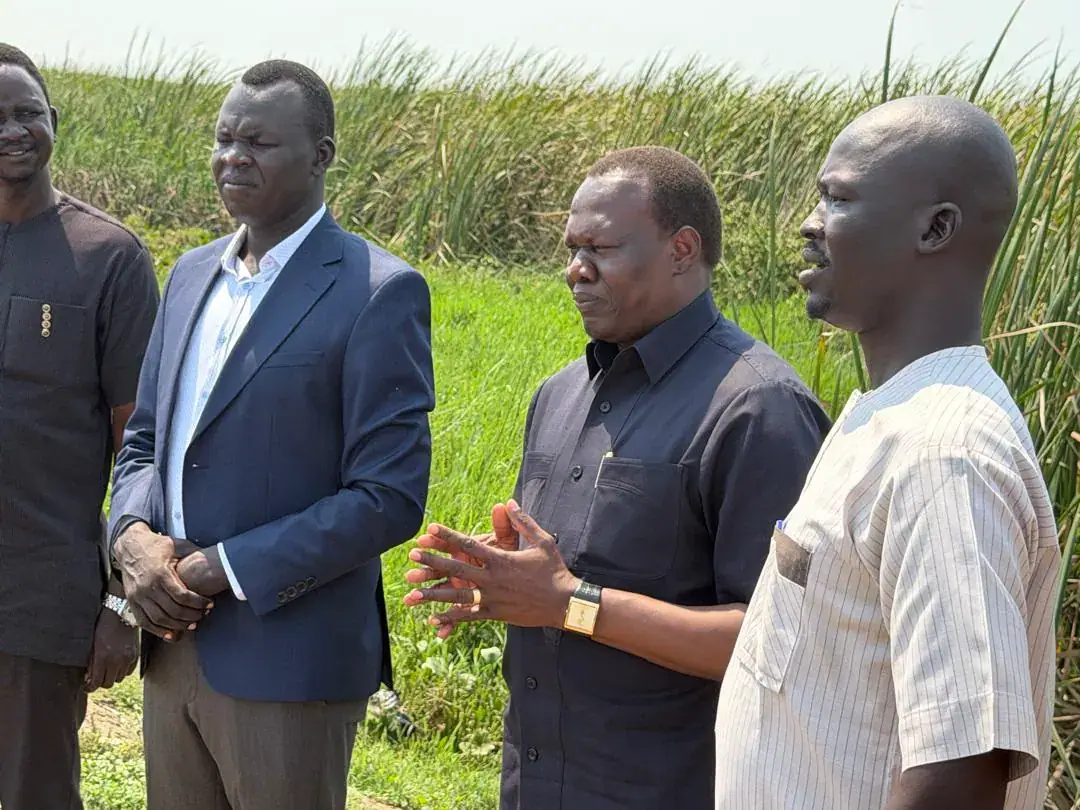
The government of South Sudan is advancing plans to build a 94-kilometre flood-protection dyke between Bor South and Twic East counties in Jonglei State. A delegation from the Ministry of Water Resources and Irrigation led by Undersecretary Sultan Lam Tungwar Kueigwong visited Jonglei State capital, Bor, to discuss the project. The proposed dyke aims to help protect communities from recurrent flooding while preserving access to water and safeguarding local livelihoods.
The delegation inspected flood-protection infrastructure under the World Bank-supported Regional Climate Resilience Programme, implemented by the International Organization for Migration (IOM). They met Jonglei State officials to discuss flood management and maintenance of existing structures. Undersecretary Lam said the proposed dyke would include culverts and wildlife crossings to reduce its impact on the environment and allow seasonal water flows and animal movement.
South Sudan has experienced severe flooding in recent years, causing widespread flooding and displacement. According to the United Nations, floods have affected an estimated 1,024,500 people across 29 counties in six states, while nearly 355,000 people have been displaced. Jonglei and Unity accounted for nearly 87 per cent of those affected. The Greater Pibor Administrative Area was also severely affected, with flooding impacting more than 43,000 people across six counties in October 2025.
Jonglei’s location in the Sudd, a vast, low-lying floodplain, makes it particularly vulnerable to inundation. The White Nile loses roughly half its flow in the region through evaporation and transpiration. Even small rises in river levels can cause widespread flooding. Undersecretary Lam emphasized that engineering solutions must be calibrated to this new reality, saying, “This is not a cyclical inconvenience; it is a permanent shift in the baseline.”
During the visit, the delegation inspected a rehabilitated dyke section at Payueny in Malou Block and drainage channel works extending from Kuocngo in Tibek Block to Langbaar D in Langbaar Block in Bor town. Discussions also focused on maintaining community access to swamp water for farming. IOM demonstrated gravity-flow pipes installed through the embankment, and further technical refinement is planned to ensure flood protection does not undermine livelihoods.
Bor Municipal Council Mayor John Dut Kuch called for improved road connectivity between Payueny and Bor Town to help residents reach healthcare and other essential services. The delegation further inspected drainage works in Bor Municipality and dyke repairs by the World Food Programme. Undersecretary Lam emphasized that drainage and water stagnation in low-lying areas require careful hydrological planning to reduce the risk of waterborne disease.
The ministry plans to visit Upper Nile, Unity, and Lakes states to assess water and flood-management needs. Further assessments are also planned in Eastern Equatoria, Warrap, and Northern Bahr el Ghazal. The Undersecretary stressed the importance of involving local communities in protecting and maintaining flood-control infrastructure, saying, “Communities must be enlightened, youths engaged, and everyone must understand that these are not government structures, they are your structures.”
Key points
- The proposed dyke is designed to be environmentally and animal-friendly, with multiple culverts and dedicated wildlife crossings.
- Floods have affected an estimated 1,024,500 people across 29 counties in six states, with Jonglei and Unity being the most affected.
- The delegation will visit several states to assess water and flood-management needs and involve local communities in protecting and maintaining flood-control infrastructure.