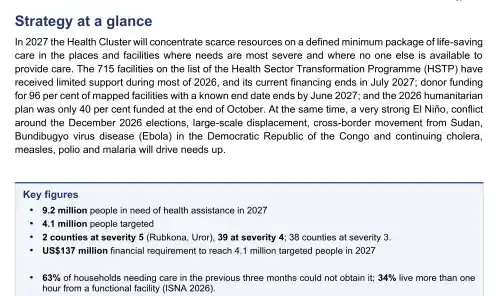
The South Sudan Health Cluster Strategy for 2027 has been released, outlining a plan to concentrate resources on providing essential healthcare services to those in need. The strategy focuses on 715 facilities listed under the Health Sector Transformation Programme (HSTP), which have received limited support in 2026 and face uncertain funding beyond July 2027. With 9.2 million people requiring health assistance, the strategy aims to target 4.1 million individuals.
The health situation in South Sudan is expected to deteriorate in 2027 due to various factors, including a strong El Niño, conflict around the December 2026 elections, large-scale displacement, and cross-border movement from Sudan. Additionally, the country faces ongoing outbreaks of cholera, measles, polio, and malaria, as well as the threat of Bundibugyo virus disease (Ebola) from the Democratic Republic of the Congo. These factors are expected to drive up health needs.
According to the strategy, 2 counties, Rubkona and Uror, have been classified as severity 5, while 39 counties are at severity 4 and 38 counties at severity 3. The financial requirement to reach 4.1 million targeted people in 2027 is estimated at US$137 million. However, funding for humanitarian health facilities is a concern, with 96% of 664 mapped facilities with a reported funding end date set to lose donor funding by June 2027.
The 2026 humanitarian plan for South Sudan was only 40% funded at the end of October, highlighting the challenges in securing resources for health initiatives. Moreover, 63% of households needing care in the previous three months were unable to obtain it, and 34% of the population lives more than one hour from a functional health facility. These statistics underscore the need for sustained support to the health sector.
Despite these challenges, health facilities in South Sudan have reported a significant workload. Between January and September 2026, over 3 million outpatient consultations were reported by 63 partners. This represents a 35% increase in patient load over the reporting period, indicating the growing demand for health services.
The HSTP project, which supports 715 health facilities, is set to end in July 2027 without a replacement program identified. This raises concerns about the continuity of health services in these facilities. The Health Cluster Strategy for 2027 aims to address these gaps and ensure the provision of life-saving care to those in need.
The South Sudan Health Cluster Strategy for 2027 is a critical initiative aimed at addressing the country's health needs. With a focus on providing essential healthcare services to 4.1 million people, the strategy seeks to mitigate the impact of various health challenges. However, the success of this strategy depends on securing the required funding and ensuring the continuity of health services.
Key points
- The strategy targets 4.1 million people, with a financial requirement of US$137 million.
Reporting sources
- South Sudan Health Cluster Strategy 2027 · pachodo.org