South Sudan is at a critical juncture as it approaches the deadline for elections scheduled for December 22, 2026. If the polls do not take place, the caretaker administration may continue to run state offices, but it will face a deeper question of legitimacy. The caretaker administration was presented as an election-period mechanism, not a new political settlement.
The mandate of the caretaker administration, led by President Salva Kiir, was established after he dissolved the Revitalized Transitional Government of National Unity, the national legislature, and state governments on September 22, 2026. The same decision removed First Vice President Dr. Riek Machar and other vice-presidents from office. According to the National Elections Act, as amended in 2026, the incumbent president can remain in office until an elected successor is sworn in.
However, the amended election law does not settle the political question created by a failed election. The 2018 peace agreement was built on power-sharing, collegial decision-making, and negotiated safeguards among former belligerents. Once those arrangements are dissolved, any prolonged caretaker period requires more than executive interpretation. It requires a lawful and publicly accepted basis, clear limits on authority, and a defined end date.
The European Union warned on September 22 that a caretaker government should concentrate on routine administration and avoid decisions with major political consequences while checks and balances are weakened. A caretaker administration should preserve essential services and public order, but not use a delayed election to restructure the security sector, entrench appointments, alter electoral rules, or silence political competition.
The continued detention and trial of Dr. Machar is part of the legitimacy problem. A July 2026 report of the UN Secretary-General recorded international calls for his release and for dialogue to restore an inclusive peace process. His case must be handled through transparent due process, independent judicial guarantees, and respect for the peace agreement.
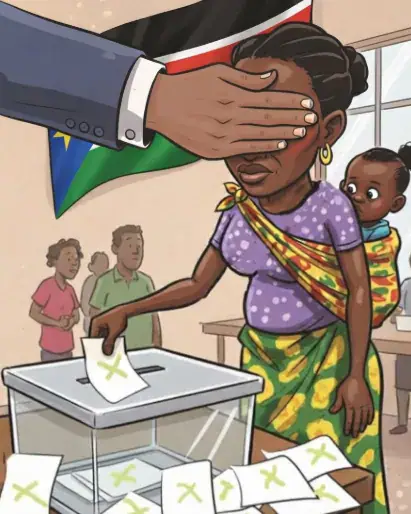
An election is not credible just because ballots are printed; it is credible when citizens can register, obtain information, and meet candidates, report abuses, and vote without fear. Public confidence is also damaged when state and security institutions are perceived as serving a party, leader, or ethnic constituency rather than the republic. Claims about ethnic domination are politically explosive and should be tested against verifiable data, not repeated as slogans.
To address the crisis, experts recommend a short, independently facilitated dialogue among the government, opposition parties, civil society, faith leaders, women's and youth representatives, refugees, and internally displaced people. The purpose should be narrow: determine the legal status of the caretaker administration, agree on the minimum conditions for elections, and adopt a schedule that cannot be extended by executive decree alone.
Key points
- The caretaker administration's legitimacy may be questioned if elections are postponed.
- A caretaker administration should concentrate on routine administration and avoid decisions with major political consequences.
- An inclusive dialogue is necessary to determine the legal status of the caretaker administration and agree on the minimum conditions for elections.