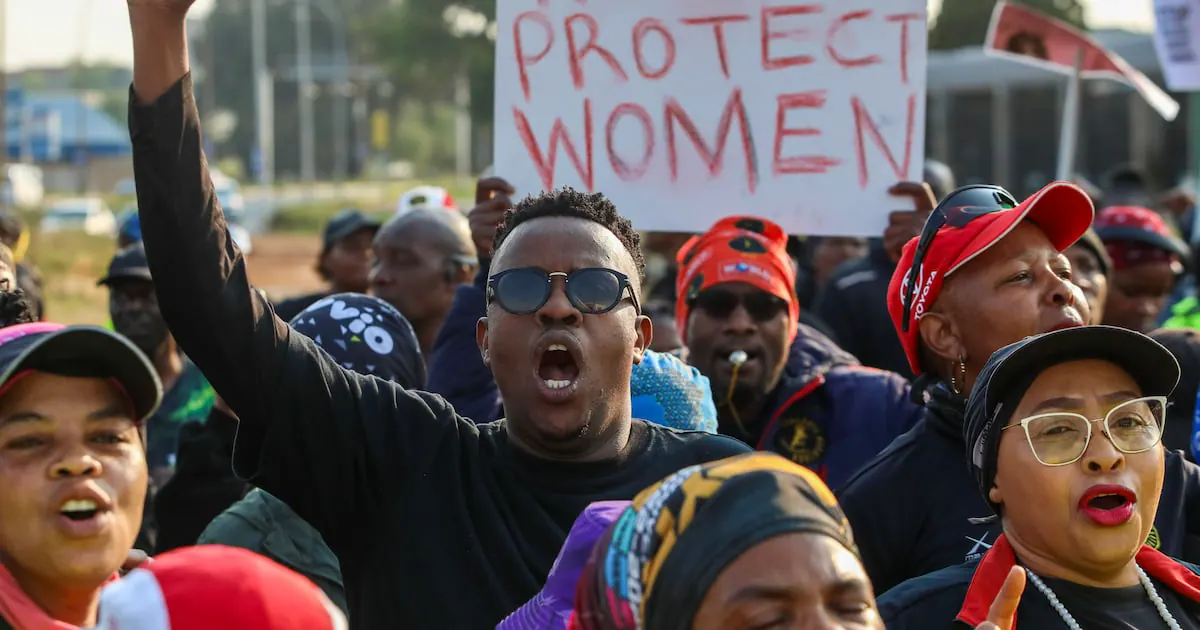
A recent surge in violence against women in Ekurhuleni, South Africa, has left authorities and citizens alike calling for urgent action. Elizabeth "Tsontso" Moselakgomo, an individual who went for a run after work, was found dead behind a hotel in Rhodesfield, Kempton Park. Her eight-year-old daughter raised the alarm after Moselakgomo failed to return home. This tragic incident is one of nine reported cases in the area since mid-July, with the bodies of the women found in various locations, including beside the R21 highway, in a veld at Olifantsfontein, in a river at Clayville, on a roadside in KwaThema, and in Dawn Park.
The South African Police Service (SAPS) has responded to the incidents by advising women in the Kempton Park area not to walk or run alone, to avoid secluded spaces, and to exercise in groups. While this advice may seem prudent, it has also been criticized for placing the onus on women to ensure their own safety, rather than addressing the root causes of the violence. The SAPS has also reported that four of the victims were sexually assaulted, highlighting the severity of the situation.
The issue of violence against women in South Africa is a pervasive one, with a 2022 study by the Human Sciences Research Council (HSRC) finding that more than 35% of women over 18 have experienced physical or sexual violence in their lifetime, often at the hands of intimate partners. The study's findings underscore the need for a comprehensive approach to addressing the problem, rather than simply advising women to take precautions.
Experts have weighed in on the issue, with some highlighting the ways in which societal attitudes and norms contribute to the problem. According to Judith Butler, a philosopher, the fact that women's bodies are being left in public spaces sends a message that "this is not your space." Butler argues that women's freedom is being curtailed by the need to be constantly vigilant and take steps to protect themselves.
The concept of a "geography of women's fear" was first introduced by Gill Valentine in 1989, who argued that blaming victims for being in the "wrong" place teaches women to fear certain spaces and shrink their lives as a result. Valentine's work highlights the need for a more nuanced understanding of the ways in which women's lives are impacted by violence and fear.
In response to the recent incidents, Ekurhuleni has promised to increase metro police visibility in Kempton Park and Rhodesfield during early mornings and late afternoons. However, experts argue that more needs to be done to address the root causes of the violence and ensure that women can move freely and safely in public spaces. This includes providing adequate lighting, maintaining and monitoring open land, and implementing systems to connect cases.
The issue of violence against women in South Africa has been recognized as a national disaster, with the government declaring it as such in November 2025. However, experts argue that more needs to be done to translate this declaration into tangible action and ensure that women can live without fear of violence.
Key points
- The South African government has declared gender-based violence and femicide a national disaster.
- Experts argue that societal attitudes and norms contribute to the problem of violence against women.
- Women in Ekurhuleni are being advised not to walk or run alone in response to a recent surge in violence.