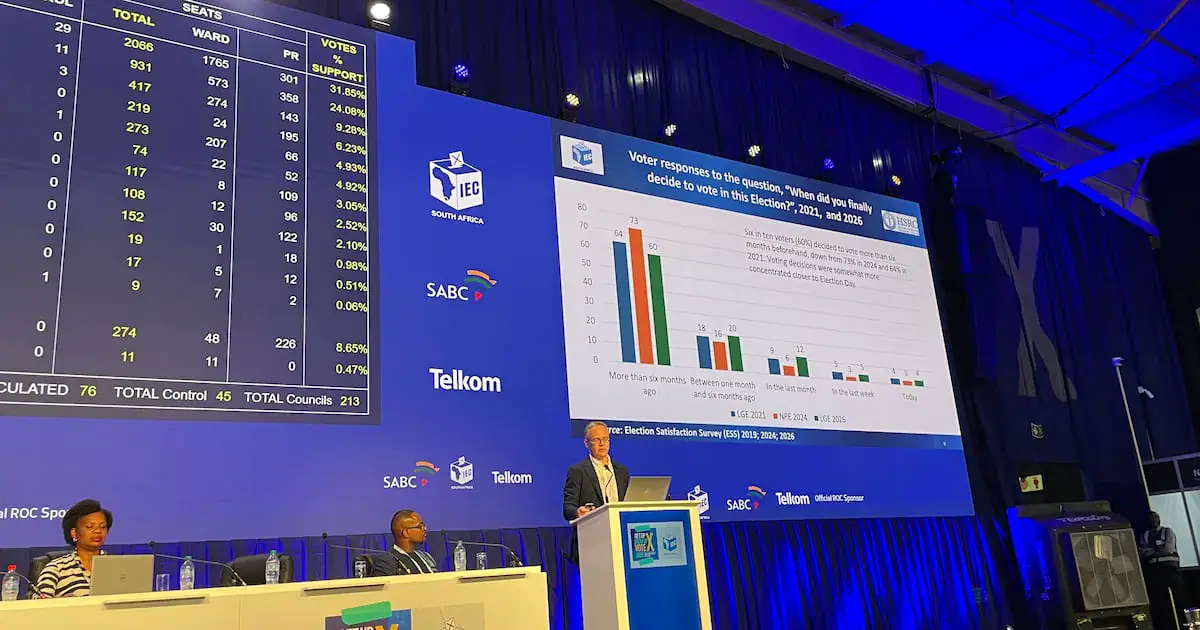
The Human Sciences Research Council (HSRC) conducted an Election Satisfaction Survey to gauge voters' opinions on the Electoral Commission of SA's (IEC) management of the 2026 local government elections. The survey interviewed 13,198 voters at 300 voting stations across all nine provinces. The results showed that South Africans who voted in the elections largely rated the electoral process as free, fair, and professionally run. This positive assessment reflects the IEC's efforts to ensure a smooth voting experience.
A significant majority of voters expressed satisfaction with the election procedures. About 90% of voters said the election procedures were free, while 91% said they were fair. Only 1% of voters said the elections were not free and fair. These findings suggest that the IEC was successful in maintaining the integrity of the voting process. The survey also found that 91% of voters waited no longer than 30 minutes to vote, with 78% waiting 15 minutes or less.
Voters were highly satisfied with the service provided by IEC officials. Around 96% of voters said they were satisfied with the service provided by IEC officials, while 79% said officials were helpful to a great extent. This high level of satisfaction indicates that IEC officials were effective in assisting voters and addressing their concerns. The survey also found that voters were likely to participate in future elections, with 96% saying they were likely to do so.
However, the survey also revealed a gradual decline in trust in the IEC. Although 81% of voters said they trusted or strongly trusted the commission, this was lower than the 91% recorded in 2016 and the 85% in 2024. This decline in trust may be a concern for the IEC, which will need to address the underlying issues to restore voter confidence.
Voter education was well received, with 88% of voters rating the IEC's voter education campaigns as effective. About 79% of voters said the campaigns were useful in providing electoral information. This suggests that the IEC's efforts to educate voters about the electoral process were successful. The survey also found that 86% of voters said voting stations were easily accessible for elderly people and persons with disabilities.
Despite the positive findings, the survey also highlighted areas for improvement. Awareness of accommodation for the partially sighted or blind, pregnant women, and voters with babies was lower. The IEC may need to consider ways to improve accessibility and inclusivity for these groups. Additionally, the decline in trust in the IEC will need to be addressed to ensure the integrity of future elections.
Overall, the survey suggests that the 2026 local government election process was successful in many respects. The high level of satisfaction with the voting process and the IEC officials is a positive sign. However, the decline in trust in the IEC and the need for improvement in accessibility and inclusivity are areas that will need to be addressed.
Key points
- 90% of voters said the election procedures were free, while 91% said they were fair.
- 96% of voters said they were satisfied with the service provided by IEC officials.
- Trust in the IEC has gradually declined, from 91% in 2016 to 81% in 2026.
Reporting sources
- The Sowetan · The Sowetan