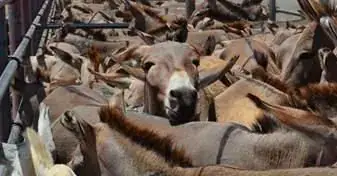
The Karoo Donkey Sanctuary has urged South Africa's Agriculture Minister, Willie Aucamp, to implement the African Union moratorium on slaughtering donkeys for their skins and publish a clear timetable for ending the trade. The sanctuary, along with other animal welfare organizations, is concerned about the welfare of donkeys being slaughtered for their skins, which are used to make ejiao, a gelatin used in traditional Chinese medicine and beauty products.
According to the Donkey Sanctuary UK, at least 5.9 million donkeys are slaughtered worldwide each year to supply the skin trade. China's donkey population has drastically declined, from about 11 million in 1992 to fewer than two million in 2020, leading the industry to look to Africa, Asia, and South America for supplies. This shift has put pressure on donkey populations in these regions, raising concerns about animal welfare and the long-term sustainability of the trade.
The Karoo Donkey Sanctuary's founder, Jonno Sherwin, emphasized the need for accountability and action from the South African government. He stated that every delay in implementing the moratorium leaves more donkeys at risk and called for a clear plan of action, including who will be accountable and when it will happen. The sanctuary is also asking for an end to the commercial slaughter of donkeys for their skins and the associated skin exports.
Animal welfare organizations have documented serious suffering during the sourcing, transport, and slaughter of donkeys, including animals being moved long distances without adequate food, water, or rest. The trade also affects families who depend on donkeys to transport water, food, and agricultural goods, as losing a donkey can mean losing an essential means of supporting themselves.
The African Union's Inter-African Bureau for Animal Resources (AU-IBAR) has called for stronger national implementation, coordinated enforcement, and action against illegal slaughter and trafficking. A report by the animal welfare charity Brooke identified South Africa as operating a controlled export model, with an annual benchmark of 10,500 donkey hides. However, the sanctuary argues that regulating the trade is not enough and that commercial slaughter for skins should be ended altogether.
In response to the sanctuary's calls, the Department of Agriculture acknowledged the AU's moratorium and stated that it is considering donkey welfare and the implications of the moratorium as animal welfare policies and legislation are reformed and updated. However, the department did not provide a timeline or draft schedule for implementation. The department also stressed that it is committed to ensuring animal health and welfare considerations are addressed within its mandate.
The Karoo Donkey Sanctuary has rescued over 300 donkeys from the skin trade, and 142 donkeys now have a permanent home at the sanctuary. The sanctuary's founder emphasized that their responsibility cannot end with the animals they have already saved and that they will continue to advocate for an end to the commercial slaughter of donkeys for their skins.
Key points
- The African Union has adopted a moratorium on donkey slaughter for the skin trade, and South Africa is being urged to implement it.
- The donkey skin trade has devastating consequences for animal welfare and rural communities, with millions of donkeys being slaughtered worldwide each year.
- The Karoo Donkey Sanctuary is calling for transparency and accountability in the trade, including the publication of current export authorizations and actual slaughter and export figures.
Reporting sources
- Slaughtered for their skins: The brutal trade threatening Africa’s donkeys · African News Agency