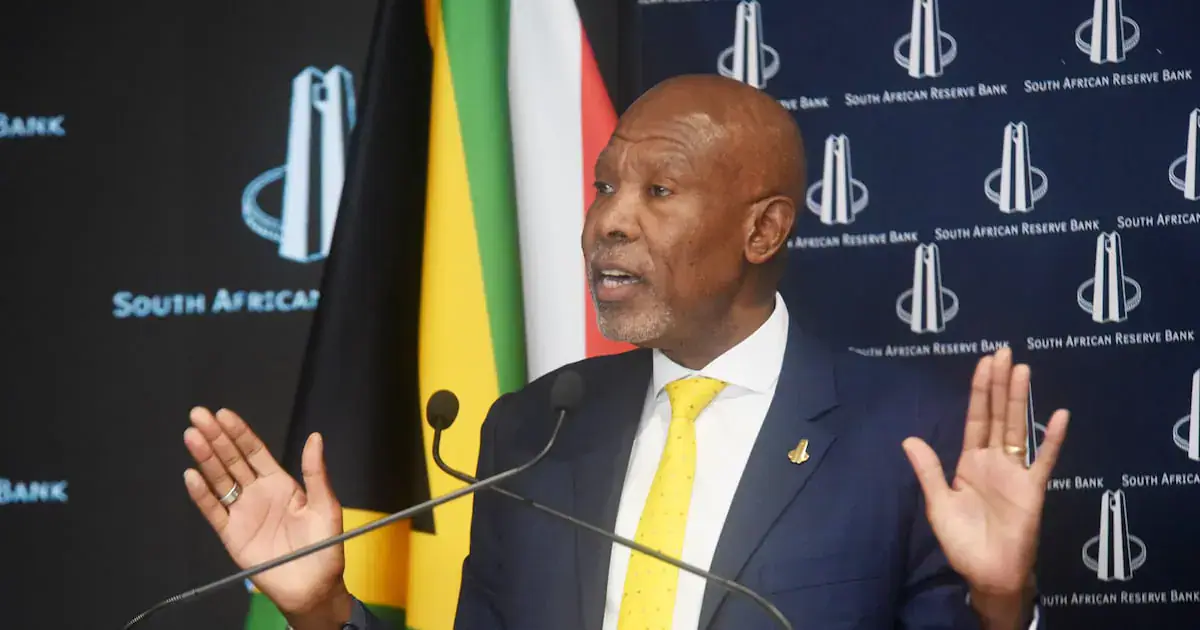
The South African Reserve Bank has announced that inflation is expected to remain above its target of 3% until early 2027. According to Governor Lesetja Kganyago, the bank's policy stance is expected to be moderately restrictive. The repo rate will remain on hold at 7.25%. Inflation has been above target since March and is expected to stay that way for several months.
Kganyago stated that the bank's forecast assumes inflation will soften beyond its current projection horizon, barring any fresh shocks. The bank's quarterly projection model shows lower rates next year, moving to more neutral policy settings based on inflation dropping back towards 3%. However, Kganyago emphasized that policy decisions will continue to be taken on a meeting-by-meeting basis, with careful attention to the outlook, data outcomes, and the balance of risks.
The bank has considered various scenarios, including the risk of energy prices increasing further. One scenario assumes oil prices peaking at $130 a barrel, leading to high fuel inflation and causing headline inflation to remain above 5% next year. Another scenario considers fiscal risks, including a weaker rand and increased risk premiums for countries like South Africa. Both scenarios suggest higher inflation, lower growth, and potential interest rate hikes.
Economists are concerned about the impact of the El Niño climate pattern on food prices, as well as the weaker rand and its effect on imported goods. Tertia Jacobs of Investec noted that the balance of risks remains skewed to the upside, citing a weaker rand, geopolitical tensions, and fuel prices as key risks. Core CPI inflation has accelerated to 4.2%, with services inflation sticky at around 5.0%.
The bank's inflation forecasts have been adjusted, with headline CPI projected at 5.1% in the fourth quarter of 2026 and 5.2% in the first quarter of 2027. The core CPI forecast remains broadly unchanged at 3.8% in 2026 and 4.0% in 2027. Lerato Ntuli of Anchor Capital noted that although the quarterly projection model suggests scope for rate cuts in 2027, policymakers have emphasized that the model serves only as a guide.
Financial markets have reacted relatively calmly to the decision, but the rand has come under pressure in recent weeks, weakening to around R17.29/$1. A weaker currency presents an additional inflation risk by increasing the local currency cost of imported goods and fuel. Ntuli highlighted the less favourable global backdrop, with major central banks facing renewed inflation pressures, which could prompt higher interest rates for longer.
The external environment remains a key risk to South Africa's inflation outlook. If the US Federal Reserve raises interest rates again in December, the interest-rate differential between South Africa and the US would narrow further, potentially placing additional pressure on the rand. A weaker currency would increase imported inflation pressures, particularly through fuel and traded goods prices, which could delay the return of inflation to target.
Key points
- Inflation expected to remain above 3% target until early 2027
- Repo rate held at 7.25%
- Risks to inflation outlook include weaker rand, El Niño, and global economic trends
Reporting sources
- # 2 Reserve Bank sees inflation hovering above target into early 2027 · The Rand Daily Mail