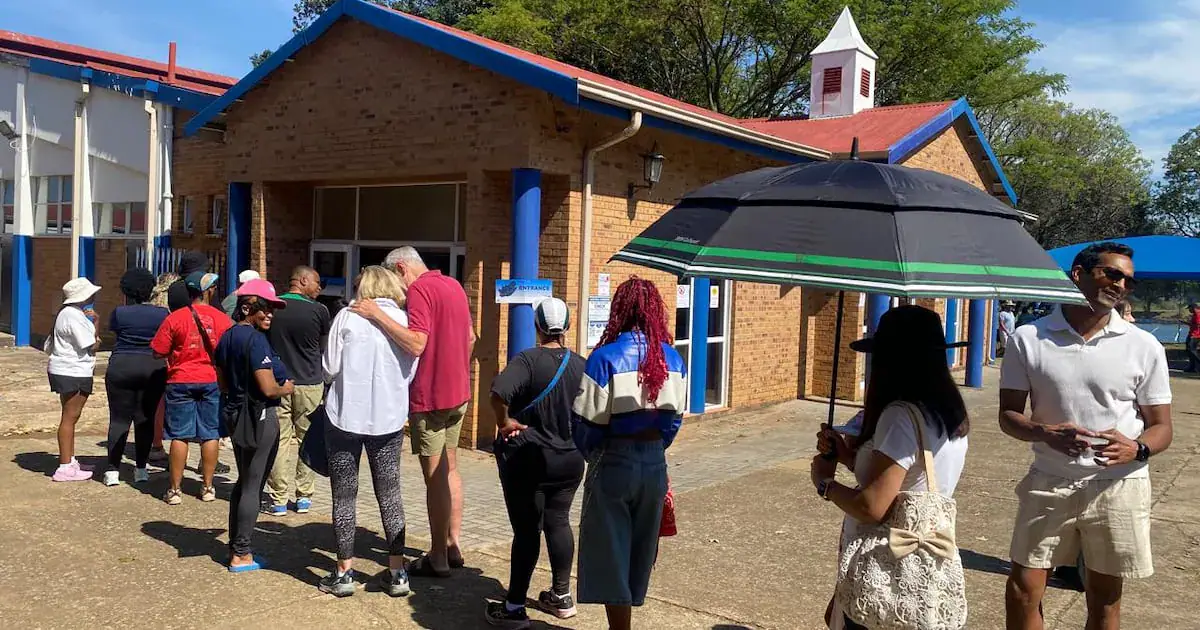
South African President Cyril Ramaphosa cast his vote in the Johannesburg suburb of Hyde Park on Wednesday, choosing to exercise his right to vote in the ward where he resides. According to Electoral Commission rules, individuals are required to vote at the station where they are registered, which in this case is Ward 90, encompassing Hyde Park, Parkmore, Illovo, and Sandhurst. This decision marks a departure from his usual voting location in Soweto, where he grew up.
Ward 90, where Ramaphosa voted, is considered a stronghold of the Democratic Alliance, the main opposition party to the ruling African National Congress. In a recent special election, the DA secured 97% of the vote in the ward, highlighting the ANC's limited influence in the area. Former presidents Thabo Mbeki and Kgalema Motlanthe also reside in Ward 90, making Ramaphosa's voting location a notable choice. The president's decision to vote in Hyde Park rather than Soweto underscores the importance of adhering to electoral regulations.
Following the vote, Ramaphosa explained that he abided by the IEC rules, which stipulate that individuals must vote where they live. He acknowledged the sentimental attachment he has to Soweto, where he grew up and buried his parents, but emphasized the need to comply with the regulations. The president's comments highlight the complexities of balancing personal connections to specific areas with the requirement to vote in one's registered ward.
In the lead-up to the local elections, Ramaphosa urged registered voters to participate in the electoral process, emphasizing that their votes could contribute to building better communities and strengthening local government. He pointed to the essential services provided by municipalities, including water, sanitation, and electricity, as critical areas where effective governance can make a tangible difference. The president's appeal to voters reflects the ANC's efforts to reconnect with its base and address pressing local concerns.
The local elections, which took place on Wednesday, represent a significant test of voter sentiment in South Africa. The ANC, which has been losing ground over the past decade, faces stiff competition from the DA, the Economic Freedom Fighters, and the MK Party, led by former president Jacob Zuma. The ANC's performance in major metros, including Johannesburg, will be closely watched, as a weak showing could add pressure on the party as it navigates a national-level coalition.
The 2021 local elections saw the ANC fall below 50% nationally for the first time since the end of apartheid, while the 2024 general election resulted in the party losing its parliamentary majority. The subsequent formation of a government of national unity, which includes the DA, has introduced new dynamics into the country's politics. Wednesday's vote provides an opportunity for voters to express their views on the ANC's performance and the effectiveness of the current coalition arrangement.
As the results of the local elections become available, the implications for the ANC and the broader South African political landscape will become clearer. A strong showing for the ANC in key metros could ease some of the pressure on the party, while a disappointing result may intensify internal debates and potentially lead to further shifts in the country's politics. The outcome of the elections will be closely watched by analysts, politicians, and citizens alike.
Key points
- President Cyril Ramaphosa voted in Hyde Park, a DA stronghold, rather than in Soweto, where he grew up.
- The ANC faces stiff competition from the DA, EFF, and MK Party in the local elections.
- The outcome of the elections will have significant implications for the ANC and the country's politics.