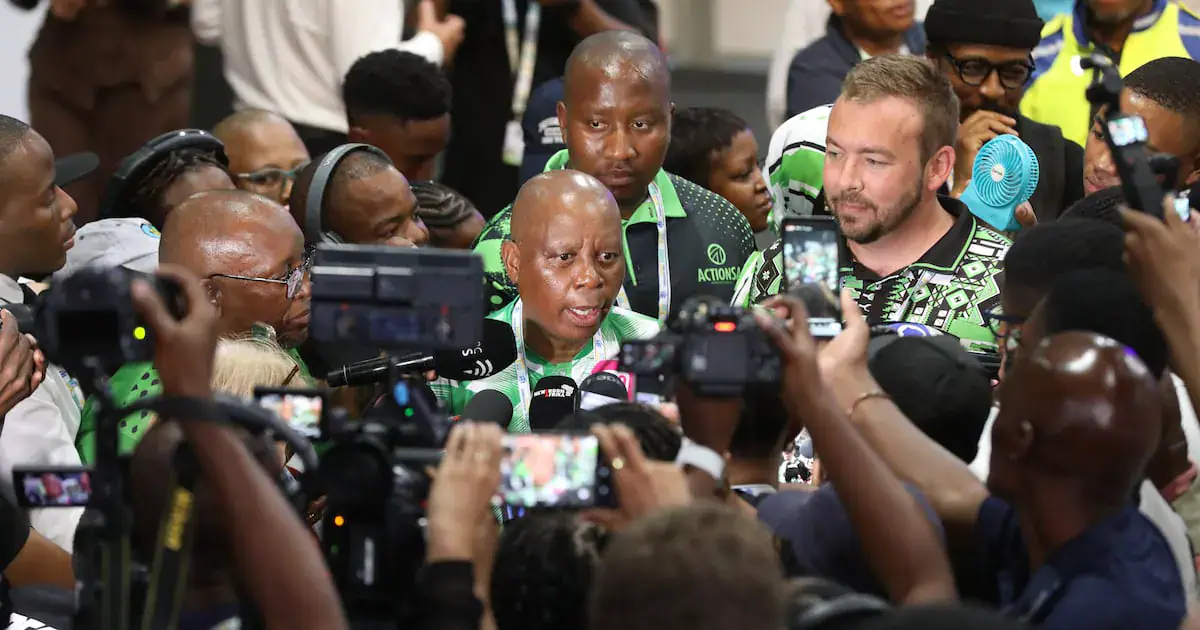
As early local government election results in South Africa point to a further fragmentation of the vote, political parties have signaled their willingness to negotiate with one another to secure governing coalitions. ActionSA national chairperson Michael Beaumont stated that "talks about talks" on coalitions had already begun, but noted that the numbers developing are a big part of these equations. Beaumont emphasized that the party has committed itself to negotiating with any political party across the political spectrum.
The Democratic Alliance (DA) has also thrown open the door to coalition talks with any political party willing to put service delivery, sound financial management, and clean governance at the centre of its agenda. DA federal chairperson Solly Msimanga stated that the party would not limit its potential coalition partners to political formations with which it shares an ideological background. This signals the DA's willingness to engage rivals across the political spectrum, including the ANC, EFF, and MK Party.
Msimanga warned that the DA will not compromise its principles or trade executive positions for political power. He emphasized that any coalition agreement must offer practical solutions to the governance and service delivery challenges facing municipalities. The DA is prepared to engage any political party that shares its commitment to stable municipalities, responsible financial governance, infrastructure investment and maintenance, and rooting out corruption and maladministration.
The possibility of parties that have previously been political opponents working together has become increasingly apparent. ActionSA and the EFF have also declared their readiness to negotiate across the political spectrum. ActionSA has already worked with the ANC and EFF to remove DA mayors in Johannesburg in 2023 and Tshwane in September 2024. In Tshwane, ActionSA joined the ANC, EFF, and other parties in removing then DA mayor Cilliers Brink.
ActionSA national chairperson Michael Beaumont stated that any coalition agreement would have to be based on commitments to improving service delivery, fighting corruption, and ensuring political stability. Beaumont also emphasized that ActionSA would insist that its coalition partners commit to addressing undocumented immigration. He revealed that the party had already been approached by other political formations, though formal negotiations had not begun.
Political analyst Tessa Dooms noted that the elections were likely to produce more coalition governments than ever before. Smaller parties and independent candidates may hold the balance of power in municipalities across the country. ANC deputy secretary-general Nomvula Mokonyane stated that the party was open to engaging political formations willing to support stability and its manifesto priorities.
EFF Tshwane mayoral candidate Omphile Maotwe acknowledged that the party was trailing in key Gauteng metros, but remained optimistic that results from its strongholds could change the picture. Maotwe attributed the party's performance partly to low voter turnout, particularly among black voters, arguing that local government elections were primarily about service delivery rather than national political ideology.
Key points
- The DA and ActionSA have signaled willingness to engage with any party that shares their commitment to service delivery and good governance.
- Coalition talks are expected to produce more coalition governments than ever before.
- Smaller parties and independent candidates may hold the balance of power in municipalities.