The South African Police Service (SAPS) is facing significant challenges in its reform efforts, with prolonged delays in implementing the Police Advisory Board leaving the institution trapped in a state of 'operational quicksand'. This has resulted in an inability to translate oversight findings into genuine institutional reform. According to Professor Jacob Mofokeng, a criminology expert at Unisa, the SAPS is at a critical juncture in its reform efforts, with public confidence in the police continuing to decline.
The announcement of the Police Advisory Board was welcomed as a potentially important intervention in the SAPS reform efforts. However, months after its introduction, uncertainty remains regarding its composition, legal mandate, authority, and relationship with existing oversight institutions. The delay has raised concerns about the political will to implement reforms, with Mofokeng noting that administrative and legislative processes invariably take time, but prolonged uncertainty inevitably raises concerns about the commitment to reform.
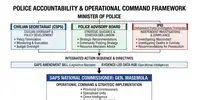
South Africa's police oversight architecture consists of several institutions with distinct responsibilities, including the Ministry of Police, the Civilian Secretariat for Police Service (CSPS), the Independent Police Investigative Directorate (Ipid), and Parliament's portfolio committee on police. Despite this, the issue is not an absence of oversight, but rather the difficulty of translating oversight findings into sustained organisational reform. Commissions of inquiry have exposed recurring governance failures, accountability deficits, leadership weaknesses, and institutional vulnerabilities that facilitate corruption and maladministration.
The SAPS reform efforts require a wider ecosystem capable of generating evidence, identifying risks, testing solutions, and evaluating outcomes over time. This includes leveraging the expertise of communities of learning, such as universities, research institutes, think tanks, and independent scholars. These institutions possess expertise in various fields, including criminology, policing, law, governance, and public administration. However, a significant obstacle to meaningful engagement between academia and industry is the publish-or-perish dilemma in South African higher education.
The publish-or-perish dilemma has resulted in an environment where senior academics face substantial pressure to attract grants and publish research outputs, leaving little room for sustained participation in public-sector reform initiatives. This has limited the depth and capacity of experts to contribute to reform efforts, despite their potential to assist in diagnosing organisational weaknesses, evaluating reform programmes, and developing integrity frameworks.
The delay in implementing reforms has significant consequences for the SAPS and the country as a whole. The institution is facing allegations of corruption, internal factionalism, and political interference, which have reinforced concerns about accountability, professionalism, and ethical leadership. The lack of implementation has also delayed urgently needed institutional renewal within the SAPS, leaving the institution vulnerable to organised crime infiltration, corruption, and intelligence failures.
To address these challenges, Mofokeng proposes a framework that integrates executive authority with complementary oversight, intelligence, and reform functions. This includes strategic legislative interventions, such as the SAPS Amendment Bill, and evidence-driven intelligence and accountability mechanisms to inform operational leadership and organisational renewal. The goal is to ensure that oversight findings, intelligence products, policy recommendations, and reform initiatives work together to drive sustainable reform.
Key points
- The South African Police Service is facing significant challenges in its reform efforts due to delayed reforms and a lack of implementation.
- The delay in implementing the Police Advisory Board has raised concerns about the political will to reform the SAPS.
- Experts propose a framework that integrates executive authority with complementary oversight, intelligence, and reform functions to drive sustainable reform.