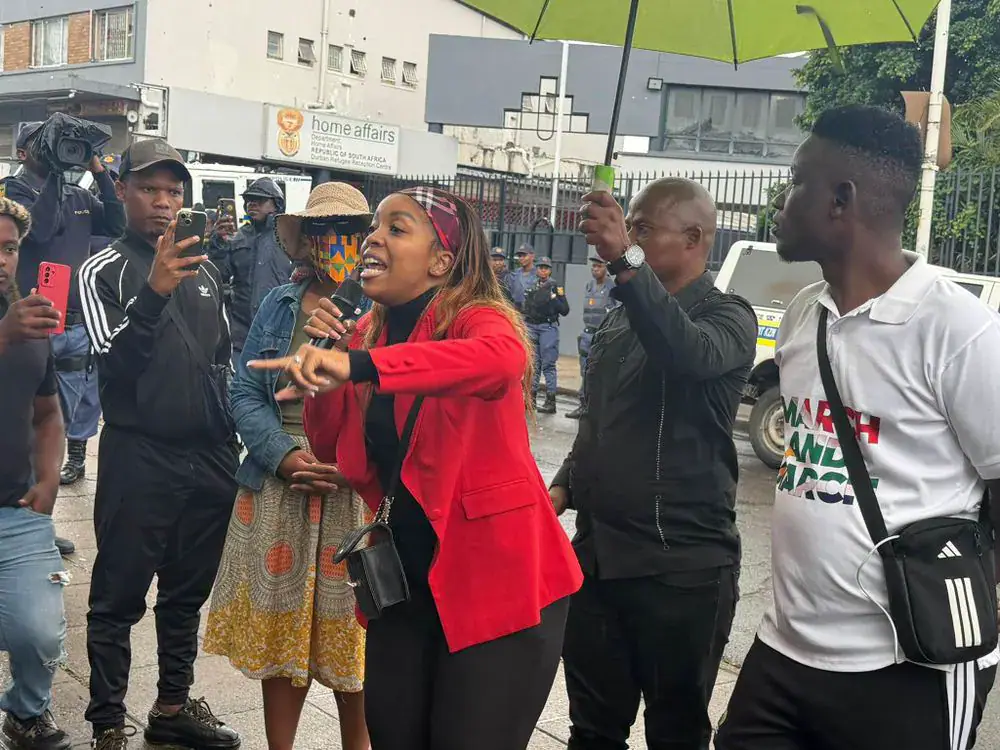
The Police Minister and KwaZulu-Natal police commissioner have applied to the Durban High Court for an urgent order to restrict marches and protests in eThekwini. The application, which is set to be heard on Friday, names March and March as the first respondent and movement leader Jacinta Ngobese Zuma as the second respondent. The eThekwini Municipality and the Minister of Home Affairs are also cited as respondents. This move aims to prevent potential disruptions and ensure public safety.
The proposed restrictions cover the entire municipal jurisdiction of eThekwini, including Durban’s central business district and Che Guevara Road in Berea. The applicants are seeking to restrict demonstrations in the vicinity of the Department of Home Affairs Refugee Reception Centre on Che Guevara Road. The order also seeks to prevent further threats, intimidation, harassment, looting, arson, and damage to public or private property. These measures are intended to maintain law and order in the area.
The applicants are also seeking to prohibit attacks on the home affairs premises, forcing businesses to close, and obstructing access to or departure from buildings. This comes as a response to concerns over public safety and potential disruptions to daily activities. The court application highlights the authorities' efforts to balance the right to protest with the need to maintain public order.
Jacinta Ngobese Zuma, the leader of March and March, has criticised the government's handling of protests and its response to communities affected by illegal mining. She accused the South African Police Service, the government, and President Cyril Ramaphosa of deploying hundreds of police officers and soldiers to KwaZulu-Natal to shoot at peaceful protesters. Ngobese Zuma also alleged that the authorities failed to protect communities being abused and displaced by zama zamas, or illegal miners.
Ngobese Zuma's comments were made on social media platform X, where she expressed her concerns over the government's actions. She confirmed that the movement would attend court on Friday, stating, "We are going to court on Friday." This indicates that March and March will defend their right to protest and challenge the government's attempts to restrict their activities.
The Police Minister and KwaZulu-Natal police commissioner's application to restrict protests in eThekwini has significant implications for the region. If the order is granted, it could limit the ability of March and March to organise and participate in protests. This, in turn, may impact the movement's ability to raise awareness about issues affecting communities in KwaZulu-Natal.
The court's decision on the matter will be closely watched by various stakeholders, including human rights groups and community leaders. The outcome will likely have far-reaching consequences for the right to protest in South Africa and the balance between public safety and freedom of expression. The case highlights the complexities of managing protests and the need for effective communication between authorities and protest leaders.
Key points
- The Police Minister and KwaZulu-Natal police commissioner are seeking an urgent court order to restrict March and March marches and protest activity in eThekwini.
- The proposed restrictions cover the entire municipal jurisdiction of eThekwini, including Durban’s central business district and Che Guevara Road in Berea.
- Jacinta Ngobese Zuma, the leader of March and March, has criticised the government's handling of protests and its response to communities affected by illegal mining.