The South African parliament recently debated the growing crisis of gender-based violence and femicide (GBVF), with some leaders calling for the reinstatement of the death penalty for those convicted of killing women. The debate comes in the wake of the recent discovery of the bodies of women in Gauteng, which has sparked widespread concern and outrage. The African Christian Democratic Party (ACDP) leader Kenneth Meshoe and African Transformation Movement (ATM) MP Thandiswa Marawu have proposed changes to the Constitution to allow for the death penalty for people convicted of killing women.
The death penalty was declared unconstitutional by the Constitutional Court in the landmark S v Makwanyane judgment in 1995. Despite this, Meshoe and Marawu argue that severe sentences are necessary to combat the growing problem of GBVF. Meshoe cited a 2016 study in Japan that found that one execution for murder deters two homicides, and argued that taxpayers should not bear the burden of housing vicious murderers in prison. Marawu also criticised the ANC's opposition to capital punishment, saying that the party's stance is "barbaric" given the inaction of government while perpetrators roam freely.
The ANC's Deputy Minister of Justice and Constitutional Development, Andries Nel, rejected the proposal, describing the call as unrealistic and populist. Nel argued that government cannot end GBVF on its own and called for a multi-faceted approach that involves civil society, religious communities, and traditional leaders. He also criticised coalition partners in the Government of National Unity, saying that they often call for changes in government but criticise it when confronted with challenges within the government.
The debate on GBVF has also led to calls for the police service to be strengthened, including through the appointment of a permanent Police Minister. The DA has called for the scourge of violence against women to be further debated, and other parties have also criticised the government and called for stronger action to combat GBVF. President Cyril Ramaphosa has acknowledged the scale of the crisis and announced measures aimed at strengthening the government's response.
Ramaphosa's measures include a national case-recovery operation focused on unresolved murders, attempted murders, rapes, and serious sexual offences involving women and children. He has also directed the police and forensic authorities to produce a funded plan within 60 days to reduce forensic backlogs and improve turnaround times for priority GBVF cases. Municipalities have also been instructed to conduct women's safety audits to identify high-risk areas.
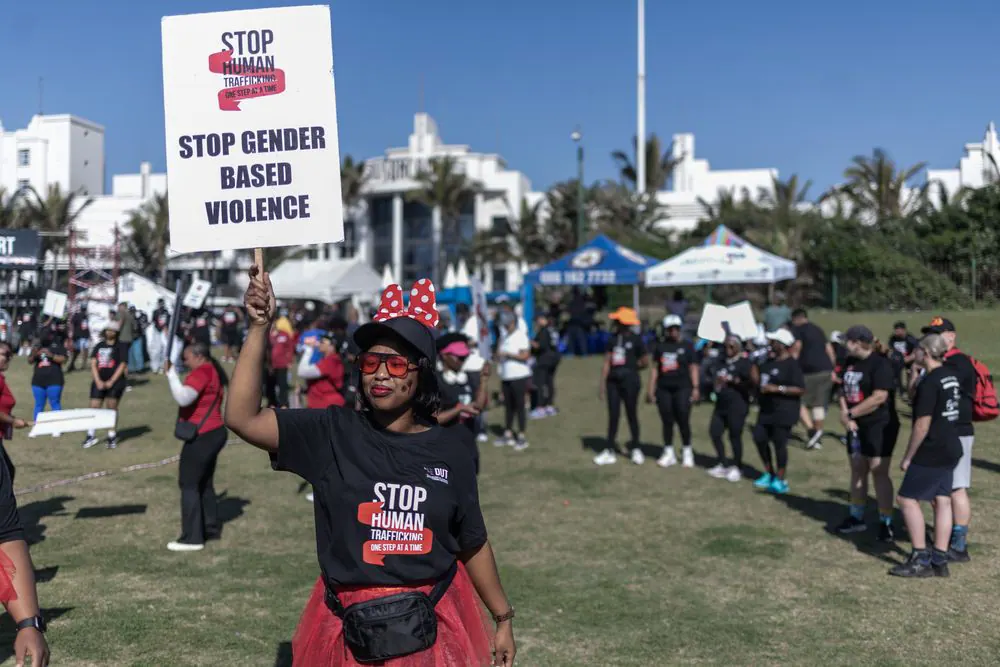
The government's response to GBVF has been criticised for being inadequate, with some arguing that more needs to be done to address the root causes of the problem. Activists against human trafficking and gender-based violence have organised protests and awareness campaigns, including a 5 km walk along the promenade in Durban under the banner "One Voice, One Fight: End Human Trafficking". The walk was organised by the Umgeni Community Empowerment Centre with the support of Durban University of Technology students and several partner organisations.
The issue of GBVF remains a major challenge for the South African government, with many arguing that more needs to be done to address the problem. The debate on the death penalty is likely to continue, with some arguing that it is a necessary measure to combat GBVF, while others argue that it is not an effective solution. The government has acknowledged the scale of the crisis and has announced measures aimed at strengthening its response, but more work remains to be done to address the root causes of GBVF.
Key points
- Some South African parliament leaders are calling for the reinstatement of the death penalty for those convicted of killing women as a way to combat GBVF.
- The ANC has rejected the proposal, describing it as unrealistic and populist.
- The government has announced measures aimed at strengthening its response to GBVF, including a national case-recovery operation and a plan to reduce forensic backlogs.