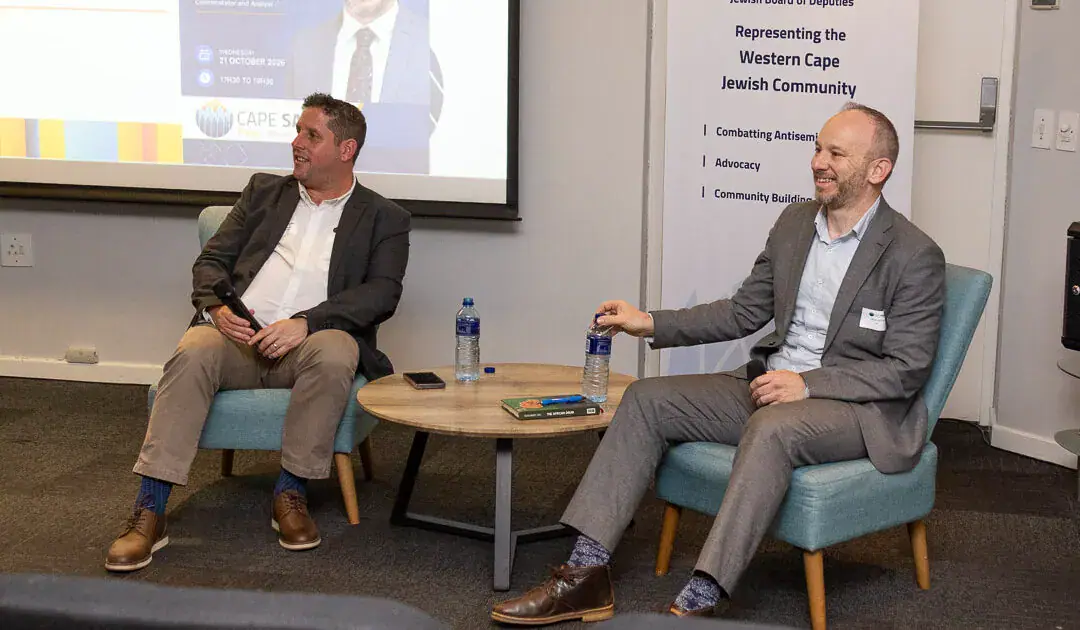
The South African local government elections, set to take place on November 4, are expected to bring significant changes across the country as dozens of political parties compete for voters. Established political loyalties are under pressure, and the outcome is far from certain. However, Cape Town may be heading in a different direction, according to elections analyst Wayne Sussman, who spoke at the Cape South African Jewish Board of Deputies (Cape SAJBD) annual general meeting on October 21.
Sussman, who analyses elections and polling for eNCA and MarkData, highlighted the fragmentation of the current political landscape. With more parties competing for support, even established political organisations face challenges in retaining voters. He suggested that the DA was well positioned to retain its outright majority in Cape Town, but Johannesburg presented a more complicated picture, with political fragmentation making the formation of a stable governing coalition uncertain.
Polling conducted across the country’s six major metropolitan areas revealed that Cape Town was the only metro where positive sentiment outweighed negative feelings. The city recorded a positive balance of 25 percentage points, while Johannesburg recorded a negative balance of 42 percentage points. These findings help explain why Sussman expects the DA to retain its majority in Cape Town, although he is less confident that it will match the 58% of the vote received previously.
The growing number of political parties is another significant factor in the elections. Sussman pointed to Tshwane, where the number of parties on the ballot has increased substantially since the 2021 local government elections. In one ward, the number of parties has risen from 37 to 67. This proliferation of choices could affect parties across the political spectrum, including the DA in the Western Cape.
Sussman also highlighted the importance of campaign organisation and leadership. Smaller parties can experience rapid growth when their leaders attract public attention, but they may struggle to sustain momentum without sufficient organisational capacity. He argued that the Patriotic Alliance’s (PA) dependence on its prominent leadership could become a vulnerability, while larger parties generally have deeper structures and more people available to campaign and govern.
Johannesburg presents a different challenge, with Sussman describing the city as politically fragmented, reflecting its diverse population and the range of parties competing for support. He pointed to Helen Zille’s campaign and the DA’s polling performance as significant developments, but noted that the central question is how a governing coalition can be formed if no party wins enough votes to govern Johannesburg alone.
The results of the elections will have broader implications, with Sussman suggesting that the ANC may fail to win any of the six largest metropolitan areas. He connected this prospect to public dissatisfaction with municipal governance, with voters increasingly concerned about whether their cities are being run effectively. The polling suggests that 66% of respondents prioritise service delivery when deciding which party to vote for, while 27% identify political identity and history as their primary considerations.
Key points
- The DA is expected to retain its majority in Cape Town.
- The ANC may fail to win any of the six largest metropolitan areas.
- Voters are increasingly prioritising service delivery when deciding which party to vote for.