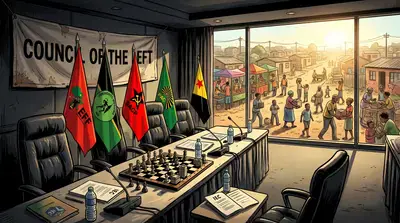
The Council of the Left, a coalition of five parties, was announced on November 12 in a Boksburg hotel. The parties claim to represent about a fifth of the vote and have vowed to back the African National Congress (ANC) only if it cuts ties with the Democratic Alliance (DA) and the Freedom Front Plus (FFP). However, the council's proposed programme for municipal councils has raised questions about its ideology and understanding of local government.
The council's programme includes ending the privatisation of national assets and rebuilding municipalities that prioritise land, decent housing, jobs, and clean water. However, the council's members have differing views on the role of the state and how to achieve their goals. For example, the South African Communist Party (SACP) sees the state as terrain to be transformed from within, while the Economic Freedom Fighters (EFF) views the state as an instrument for a disciplined vanguard to expropriate and nationalise.
The council's members also have different perspectives on the role of ideology in local government. Dali Mpofu has stated that local government is "not really a place for ideological contestation," but this view is at odds with the council's proposed programme, which is ideological in nature. The council's aim is for municipalities to become real centres of people's power, but it is unclear how this would be achieved.
The council's composition has also raised questions about its legitimacy and representation. The EFF and uMkhonto weSizwe (MK) were both founded by expelled former ANC leaders, while the African Congress of Transformation (ACT) split from the ANC in 2023. The SACP was the ANC's partner for a century, and the council's conditional offer to the ANC has been seen as an attempt to dictate terms.
The council's design has been criticised for guaranteeing a outcome where coalition arithmetic dissolves principle. Parties that call the DA "reactionary" at the podium receive its calls in the corridor, highlighting the tension between the council's rhetoric and its actions. The council's inability to coordinate action among its members has been attributed to its members' differing views on the state and its role.
The concept of uniting the working class has been highlighted as a key challenge for the council. Uniting the Left means negotiating among leaderships, while uniting the working class is built through shared struggle and understanding that a South African worker has more in common with a migrant worker from Zimbabwe than with a South African black capitalist.
The council's future and its ability to present a united front remain uncertain. Its members' differing views on the state and its role, as well as their perspectives on ideology and local government, will need to be addressed if the council is to achieve its goals. The council's impact on the ANC and the broader South African political landscape will also be closely watched.
Key points
- The Council of the Left's proposed programme for municipal councils includes ending the privatisation of national assets and rebuilding municipalities that prioritise land, decent housing, jobs, and clean water.
Reporting sources
- The council confusion of the left · Mail & Guardian