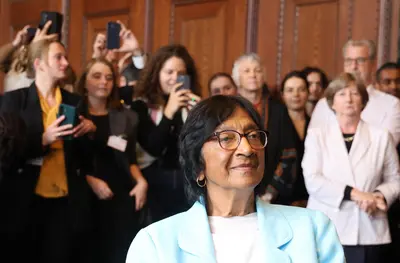
Veteran South African jurist Navi Pillay, 85, has been awarded the 2026 Nobel Peace Prize for her decades-long fight against international crimes and genocide. Pillay dedicated the prestigious accolade to survivors of international atrocities during a press briefing in Nuremberg, Germany. The Norwegian Nobel Committee recognized Pillay's comprehensive career, including leading the Rwanda tribunal and serving as UN High Commissioner for Human Rights.
Pillay becomes the fifth South African to receive the Nobel Peace Prize, following Albert Luthuli, Desmond Tutu, Nelson Mandela, and FW de Klerk. The award drew global praise from leaders such as South African President Cyril Ramaphosa and European Commission chief Ursula von der Leyen. Ramaphosa welcomed the announcement, describing it as a "profound tribute to the veteran jurist's courage, integrity and lifelong commitment to justice".
The Norwegian Nobel Committee stressed that the prize honors Pillay's comprehensive career and her role in ensuring that war crimes, crimes against humanity, and genocide are prosecuted. Committee chair Jorgen Watne Frydnes said Pillay had been "instrumental in ensuring that war crimes, crimes against humanity, and genocide are prosecuted". Pillay's independence, expertise, and steadfastness have made her one of the most respected international jurists of our time.
Born into a South African family of Tamil descent, Pillay began her legal career defending anti-apartheid activists. She became South Africa's first non-white woman High Court judge and, in 1973, secured the right of political prisoners on Robben Island, where Nelson Mandela was imprisoned, to have access to lawyers. Her career subsequently took her to the International Criminal Tribunal for Rwanda and the International Criminal Court.
Pillay also served as UN High Commissioner for Human Rights from 2008 to 2014. More recently, she headed the UN Independent International Commission of Inquiry, which last year concluded that genocide was occurring in Gaza. The commission shared "thousands of pieces of information" with prosecutors at the International Criminal Court. Israel rejected the commission's findings as "distorted and false".
The award triggered fierce condemnation from Israel over Pillay's leadership of the UN commission investigating the conflict in Gaza. Israel's foreign ministry strongly condemned the Nobel decision, calling it the "grotesque weaponisation of an award to legitimise anti-Israel hatred and prejudice". The ministry referred to the Nazi propagandist Joseph Goebbels, saying he would be "applauding from hell".
Pillay, who is currently serving as a judge at the International Court of Justice in a case involving allegations of genocide against Myanmar, appeared surprised by the controversy surrounding her work. The Nobel committee stressed that the award recognized Pillay's broader career and did not constitute a finding on whether Israel had committed genocide in Gaza.
Key points
- Navi Pillay is the fifth South African to receive the Nobel Peace Prize.
- The award recognizes Pillay's decades-long fight against international crimes and genocide.
- The decision triggered fierce condemnation from Israel over Pillay's leadership of a UN commission investigating the conflict in Gaza.