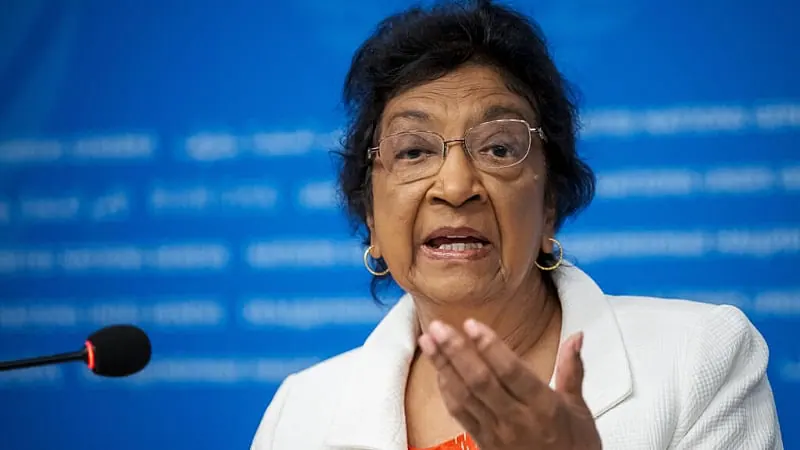
The Norwegian Nobel Committee has awarded the Nobel Peace Prize to South African judge Navi Pillay, recognizing her tireless efforts in defending human rights and ensuring that war crimes, crimes against humanity, and genocide are prosecuted. Pillay, 85, is a renowned legal expert who has served as a judge in several key international court cases. Her work has been instrumental in promoting justice and accountability globally.
Pillay's achievements were highlighted by the Nobel Committee, which noted that a common thread runs through her early work defending Nelson Mandela and others who stood up against apartheid to her service as a judge in international court cases. The committee described her as "one of the most courageous and important legal experts of our time" and emphasized that her work is crucial at a time when the system of international law is under tremendous pressure.
Pillay currently serves as a judge on the International Court of Justice (ICJ), where she is involved in a case against Myanmar, which is also accused of genocide. Her work with the UN Independent International Commission of Inquiry (COI) has been particularly notable, as she headed a team that found evidence of genocide in Gaza and shared thousands of pieces of information with prosecutors at the International Criminal Court.
The Nobel Peace Prize was announced on the same day that Pakistan nominated US President Donald Trump for the award, citing his role in advancing peace in South Asia. However, the White House criticized the committee, accusing them of putting "politics over peace." Pillay responded to the nomination by jokingly suggesting that she might share the prize with Trump, saying "If you clap a little bit more I may share this prize with Trump."
The Nobel Peace Prize comes with a gold medal, a diploma, and a prize sum of $1.2 million. The award will be presented at a formal ceremony in Oslo on December 10, the anniversary of the death of Alfred Nobel, the creator of the prizes. This is the 11th time that a person or organization from Africa has received the annual distinction, and Pillay is the second African woman to be honored, following Kenya's Wangari Maathai in 2004.
Pillay is the fifth South African to receive the Nobel Peace Prize, following Albert Luthuli in 1960, Desmond Tutu in 1984, and Nelson Mandela and Frederik de Klerk in 1993. The UN has welcomed the prize, saying it is a testament to the value of human rights. International Criminal Court president Tomoko Akane also praised the award, saying it carries particular significance at a time of profound challenges to the international legal order and the rule of law.
The Nobel Committee's decision to award Pillay the peace prize has been seen as a recognition of her dedication to promoting justice and human rights. Her work has had a significant impact on the international community, and her award is expected to inspire others to continue her legacy. The ceremony in Oslo will provide an opportunity for Pillay to accept the award and share her vision for a more just and peaceful world.
Key points
- Navi Pillay was awarded the Nobel Peace Prize for her work in defending human rights and ensuring war crimes are prosecuted.
- Pillay is the second African woman to receive the Nobel Peace Prize, following Kenya's Wangari Maathai in 2004.
- The award was announced on the same day that Pakistan nominated US President Donald Trump for the prize, sparking criticism from the White House.