In South Africa, survivors of gender-based violence (GBV) often struggle to recover due to undiagnosed brain injuries caused by head trauma and strangulation. These hidden injuries can disrupt sleep, blur memory, and dull a survivor's ability to plan and make sound decisions. Despite the severity of these injuries, they often remain undiagnosed as hospital departments operate in silos, failing to share a common clinical language.
The South African Police Service's (SAPS) 2026/27 second-quarter crime statistics reveal 581 women and 149 children were murdered, 9,908 rapes were recorded, and 41,919 cases of assault with intent to inflict grievous bodily harm were opened in just 92 days. The Human Sciences Research Council's (HSRC) finding that more than one in three adult women in South Africa has endured physical or sexual violence underscores the scale of the GBVF emergency.
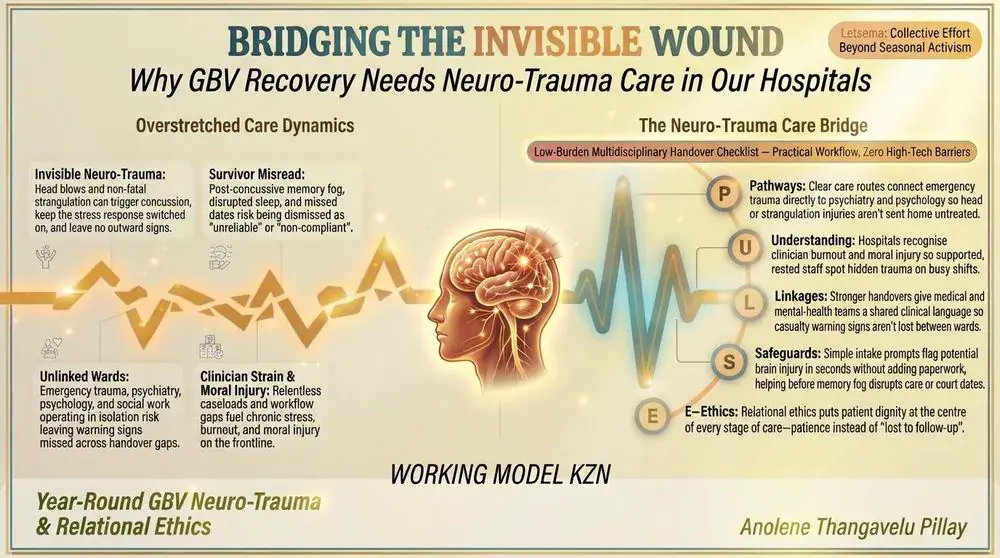
Hospital departments often dismiss survivors as "unreliable" or "non-compliant" when they struggle to recall dates in court or miss clinic follow-ups due to post-concussive brain fog. However, this is often a result of untreated brain injuries. To address this, the Neuro-Trauma Care Bridge, a working health-systems framework, has been designed for KwaZulu-Natal hospitals to examine acute GBV neuro-trauma care lines and clinician strain.
The Neuro-Trauma Care Bridge is guided by the P.U.L.S.E. framework, which includes Pathways, Understanding, Linkages, Safeguards, and Ethics. This framework aims to provide clear care routes, recognize clinician burnout and moral injury, and ensure patient dignity at every stage of care. By supporting frontline clinicians and providing them with practical workflow refinement, the framework seeks to bridge the gap in GBV care.
The P.U.L.S.E. framework's Linkages component aims to provide stronger handovers between medical and mental-health teams, giving them a shared clinical language. This ensures that vital warning signs observed in casualty are not lost between wards. Additionally, the Safeguards component includes simple intake prompts that flag potential brain injury in seconds, helping survivors before memory fog disrupts clinic visits or court dates.
Anolene Thangavelu Pillay, a South African opinion writer and psychology advisor, emphasizes that until neuro-trauma is treated with the same urgency as a broken bone, South Africa's GBVF numbers will persist. She argues that if every emergency admission became an acute-care bridge to safety and the starting point of lasting neuro-trauma recovery, the country could dramatically drive down GBVF numbers.
The 16 Days of Activism for No Violence Against Women and Children, which took place under the theme "Letsema: Men, Women, Boys and Girls Working Together to End Gender-Based Violence and Femicide," highlights the need for year-round structural action to address GBV. By working together and implementing frameworks like P.U.L.S.E., South Africa can make progress in reducing GBV and supporting survivors.
Key points
- Undiagnosed brain injuries from head trauma and strangulation are a major obstacle to GBV survivors' recovery in South Africa.
- Hospital handover gaps and lack of integrated neuro-trauma care contribute to poor outcomes for GBV survivors.
- The P.U.L.S.E. framework offers a practical solution to addressing these gaps and improving GBV care in South African hospitals.