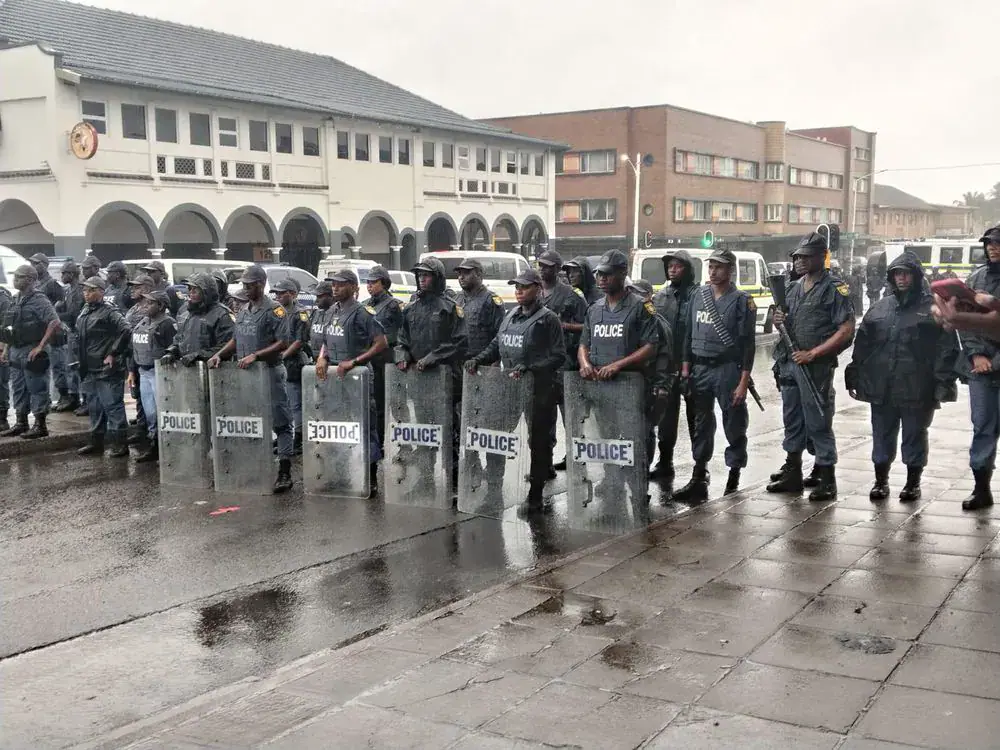
A heavy police presence has been deployed across major roads in the South African city of Durban, as a court hearing gets underway to decide on restrictions imposed on the March and March anti-immigration group. The group, led by Jacinta Ngobese Zuma, has been at the center of recent protests against undocumented immigrants in the country. The protests have been marked by violence and vandalism, prompting the government to seek restrictions on the group's activities.
The government has asked the court to rule that the group and its leaders must notify the police in advance of any planned protests. The government also wants the court to prohibit the group from protesting in certain areas, including the city center, Che Guevara Road, and near the Home Affairs Refugee Reception Centre. The government argues that the protests have been causing harm to businesses and government employees, and that the restrictions are necessary to maintain public safety.
The March and March group has denied responsibility for the violence and vandalism that has occurred during the protests. According to Ngobese Zuma, the group is committed to peaceful protest and is seeking to highlight the issue of undocumented immigration in the country. Ngobese Zuma has stated that the group will not be silenced and will continue to fight for what it believes in.
The court hearing is expected to determine whether the restrictions imposed on the group are justified. The government has argued that the restrictions are necessary to prevent further violence and damage to property. The March and March group has argued that the restrictions are an attempt to suppress its right to freedom of expression and assembly.
A large number of roads leading to the court have been closed, with many people forced to walk to the hearing. The city is experiencing significant traffic congestion as a result of the police presence and the court hearing. The restrictions have also caused disruptions to businesses and daily activities in the area.
The issue of undocumented immigration has been a contentious one in South Africa, with many citizens expressing frustration and anger at the perceived impact on the country's economy and social services. The March and March group's protests have highlighted the need for a comprehensive solution to the issue, but have also raised concerns about the use of violence and intimidation as a means of achieving their goals.
The court's decision on the restrictions imposed on the March and March group is expected to have significant implications for the group's ability to protest and express its views. The outcome of the hearing will also have implications for the broader debate on undocumented immigration in South Africa and the role of protest and activism in addressing social and economic issues.
Key points
- The South African court is set to decide on restrictions imposed on the March and March anti-immigration group.
- The group has denied responsibility for violence and vandalism during protests.
- The court's decision will have implications for the group's ability to protest and express its views.