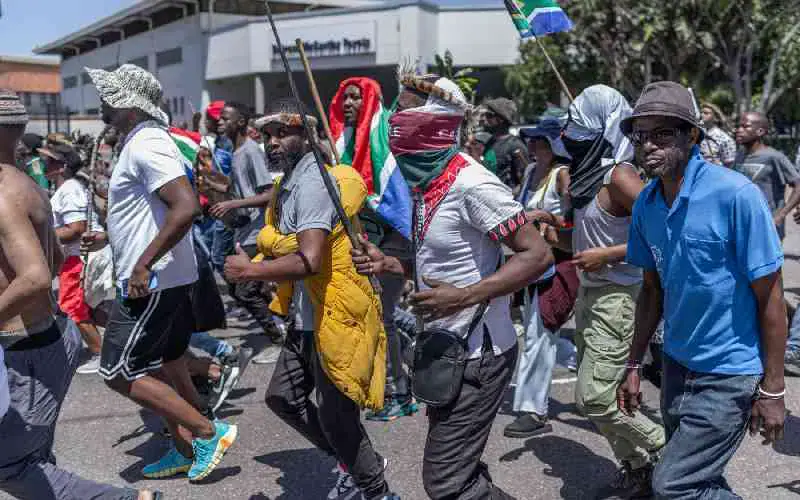
A South African court has imposed strict conditions on anti-migrant demonstrations planned by the March and March movement. The demonstrations, which have turned violent in the past, were set to take place in the coastal city of Durban. The court ruling comes amid heightened tensions and misinformation surrounding a Constitutional Court decision on asylum seekers. Hundreds of protesters gathered outside the court, waving placards and chanting slogans.
The March and March movement, which has organised demonstrations against undocumented foreigners across the country, had its application amended by the government. The group is now required to march between 9am and 3pm, and participants are barred from carrying weapons or covering their faces. The group was also prohibited from destroying property or setting fire to buildings. The matter is expected to return to court next year.
The court action was brought by acting Police Minister Firoz Cachalia, who cited police intelligence about an alleged plot to set fire to the Home Affairs Refugee Reception Centre in Berea, an inner-city suburb of Durban. The police claimed that the situation in Durban had "degenerated into lawlessness" and that reactive policing could no longer contain the violence. More than 400 police officers had been deployed to the area.
The unrest has been fuelled by misinformation about a July Constitutional Court ruling that asylum seekers cannot be denied access to South Africa's asylum system solely on procedural grounds. According to the police, this has led to widespread violence and attacks on foreign nationals. At least five foreign nationals have been killed in anti-migrant violence this year, although some African governments have put the toll higher.
The court battle comes days before local elections on November 4, with lawyers warning that police are already stretched thin ahead of the vote. Populist groups leading the demonstrations accuse migrants of taking jobs and public services from South Africans, an issue that has become a flashpoint ahead of the polls. The March and March movement defended its right to demonstrate under the constitution, distancing itself from the violence.
Supporters of several political parties, including the centre-right ActionSA and the uMkhonto weSizwe (MK) party led by former president Jacob Zuma, turned out in solidarity with the March and March movement. Judge Peter Olsen allowed the group to proceed with its planned demonstrations, but under the strict conditions. The police had sought to stop the demonstrations on the grounds that they threaten public order and the safety of foreign nationals.
The demonstrations have been a focal point of anti-migrant agitation in the Zulu heartland of Durban. President Cyril Ramaphosa has deployed more than 500 soldiers to support the police in the area. The March and March movement's legal representative, Xolani Zuma, told reporters that the agenda was to try and silence the people, and that the real problem was illegal immigrants who were "terrorising people".
Key points
- A South African court has ruled that anti-migrant demonstrations can proceed, but with strict conditions.
- The demonstrations have turned violent in the past, leaving one person dead and at least five foreign nationals killed this year.
- The court ruling comes amid heightened tensions and misinformation surrounding a Constitutional Court decision on asylum seekers.