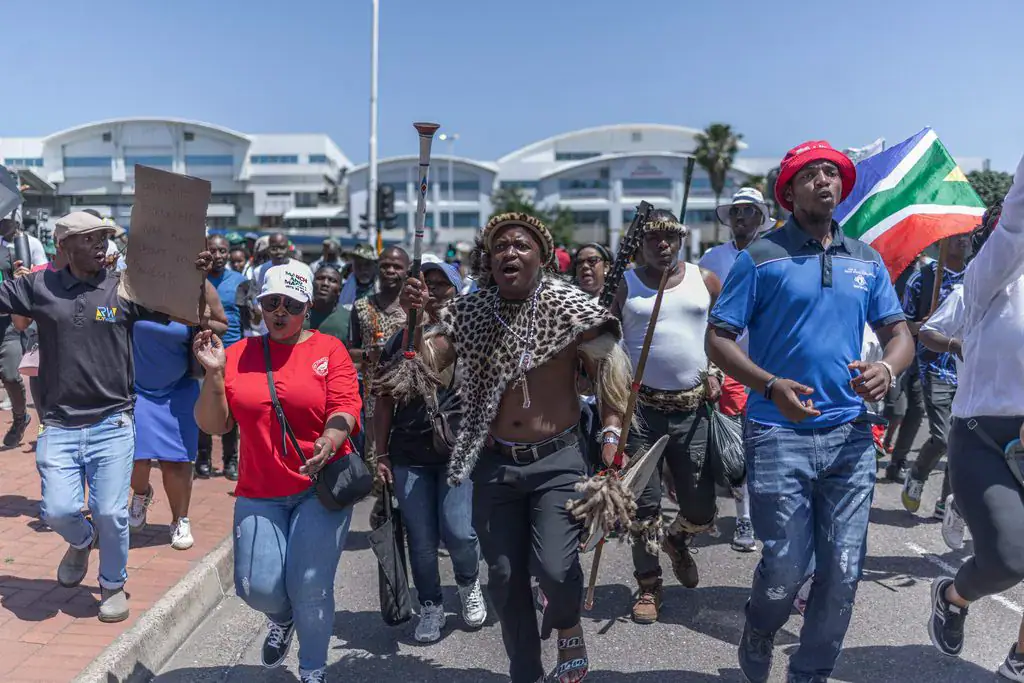
A South African court has imposed restrictions on anti-migrant protests, limiting them to daytime hours and banning masks and weapons. The decision was made on Friday in the coastal city of Durban, which has been at the epicenter of anti-migrant protests in recent months. The protests have been sparked by concerns over the presence of migrants in the country, with some South Africans accusing them of taking jobs and straining resources.
The restrictions were imposed in response to a lawsuit filed by the Minister of Police, Firoz Cachalia, who argued that the protests posed a threat to public order and the safety of foreign nationals. The court's decision allows protesters to march only between 9am and 3pm, and bans them from wearing masks or carrying weapons. The move is seen as an effort to prevent the kind of violence that has marred previous protests, including the lynching of a foreign national last week.
The anti-migrant protests have been organized by various groups, including the "March and March" movement, which has been critical of the government's handling of the issue. The movement's supporters, as well as those from other political parties, including ActionSA and the uMkhonto weSizwe party led by former President Jacob Zuma, gathered outside the court on Friday to show their support for the protests.
The violence against migrants has been a major concern in South Africa, with at least five foreign nationals killed in anti-migrant violence this year, according to police. However, some governments have reported higher numbers of fatalities. The issue has also sparked tensions between South Africa and other African countries, with some governments accusing the South African government of not doing enough to protect the rights of their citizens.
The restrictions on the protests come ahead of municipal elections scheduled for next Wednesday, in which the ruling party is expected to face a strong challenge from opposition parties. The deployment of 550 military personnel to the province of KwaZulu-Natal, where Durban is located, was also seen as an effort to maintain order and prevent further violence.
The issue of migration has been a contentious one in South Africa, with many citizens expressing frustration over the presence of foreigners in the country. However, human rights groups have argued that the government has a responsibility to protect the rights of all people, regardless of their nationality. The court's decision is seen as a compromise between the need to maintain public order and the right to freedom of expression.
The restrictions on the protests are also seen as a reflection of the government's efforts to balance the need to address the concerns of its citizens with the need to maintain stability and security in the country. The issue of migration is likely to remain a major challenge for the government in the coming months, and the court's decision is seen as a step towards finding a solution that works for all parties involved.
Key points
- A South African court has imposed restrictions on anti-migrant protests, limiting them to daytime hours and banning masks and weapons.
- The restrictions were imposed in response to a lawsuit filed by the Minister of Police, who argued that the protests posed a threat to public order and the safety of foreign nationals.
- The issue of migration has been a contentious one in South Africa, with many citizens expressing frustration over the presence of foreigners in the country.