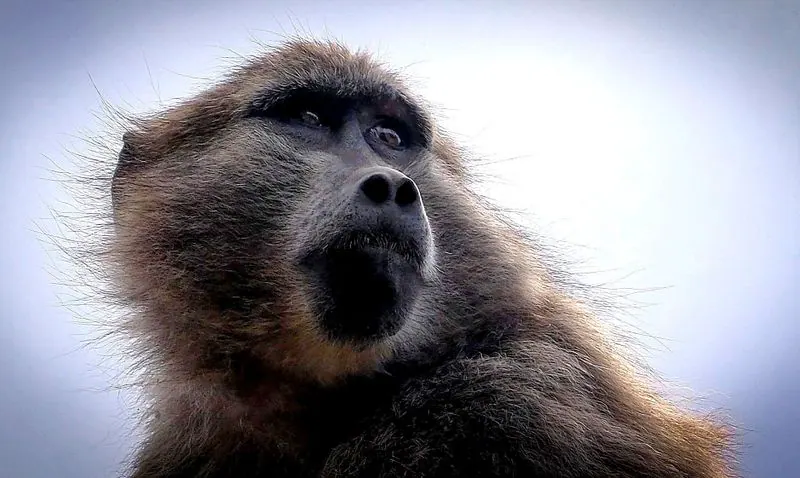
In a heartfelt letter, Jane of the Waterfall baboon troop in Simon's Town, South Africa, has expressed her fears and concerns over the planned capture and relocation of her troop to a sanctuary. The troop, which has long inhabited the Waterfall valley, is facing an uncertain future as authorities prepare to capture and relocate them to a controlled environment. Jane's letter, addressed to the "tall tailless" humans, conveys the troop's anxiety and sadness over the prospect of being taken away from their home.
According to Jane, the troop is worried that they will be confined to a small enclosure with limited space and freedom. She notes that the proposed sanctuary will have 44 baboons from the Waterfall troop and 16 from the Seaforth troop, with amenities such as climbing ropes, sleeping platforms, and a reliable water supply. However, Jane is concerned that this new environment will not provide the same sense of freedom and connection to their natural habitat that they currently enjoy. She also questions the true intentions of the humans, suggesting that the ultimate goal may be to prevent the baboons from reproducing.
Jane's letter highlights the complex and interconnected history between humans and baboons in the region. She notes that their ancestors once shared a common lineage, but over time, humans developed different characteristics, such as clothes, guns, and bread, while the baboons retained their tails and strong muscles. Jane also acknowledges that conflicts have arisen between humans and baboons, particularly as human settlements and agriculture have expanded into the baboons' natural habitat.
The proposed relocation has sparked debate among humans, with some advocating for alternative solutions that prioritize coexistence and conservation. Two young human females, Erin and Shreya, have proposed exploring options that allow the baboons to remain in the wild while minimizing conflicts with humans. Their suggestions include securing trash cans, installing fences around areas that attract baboons, and establishing boundaries that protect both humans and baboons.
However, concerns have been raised about the long-term viability of such solutions, particularly if funding becomes scarce. According to Jane, the current plan allows for the baboons to be killed if the funding runs out or if no alternative solution can be found. This has raised concerns about the security of the baboons' future, even within the proposed sanctuary. Furthermore, the plan includes provisions for emergency situations, such as fires, where the baboons will be allowed to leave the enclosure but must return afterwards.
Jane's letter has resonated with many who are concerned about the welfare of the Waterfall baboon troop. Her words serve as a poignant reminder of the complex relationships between humans and animals in shared environments. As the situation unfolds, it remains to be seen whether a solution can be found that balances the needs and concerns of both humans and baboons. The Waterfall troop's story has sparked a wider conversation about the management of urban baboon populations and the importance of finding humane and sustainable solutions.
The issue has also raised questions about the role of humans in managing and conserving wildlife populations. As the debate continues, Jane's letter serves as a powerful reminder of the need for empathy, understanding, and cooperation between humans and animals. The outcome of this situation will have significant implications for the future of the Waterfall baboon troop and may set a precedent for the management of similar conflicts in the region.
Key points
- The Waterfall baboon troop in Simon's Town, South Africa, faces an uncertain future as authorities plan to capture and relocate them to a sanctuary.
- The troop's concerns are centered around the loss of freedom and connection to their natural habitat.
- Alternative solutions prioritizing coexistence and conservation have been proposed, but concerns remain about their long-term viability.