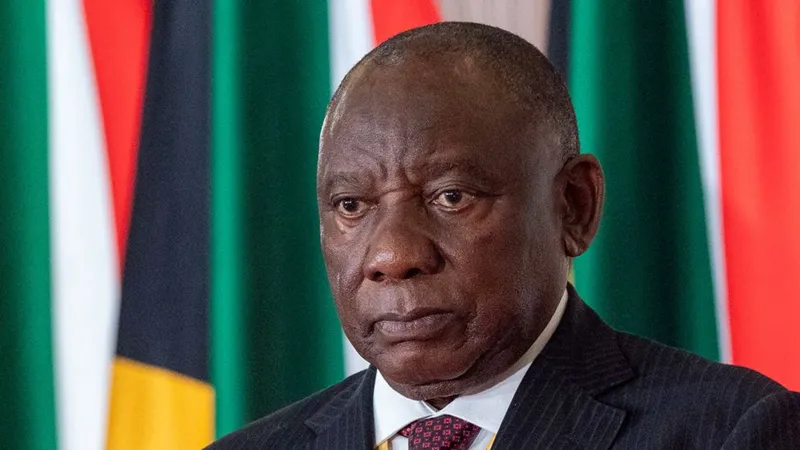
South African President Cyril Ramaphosa has announced a multidisciplinary, national-level emergency response to address the recent killings of 12 women in an area east of Johannesburg. The bodies were discovered over a two-month period, sparking a national outcry about the scale of violence against women in South Africa. Ramaphosa acknowledged that the country has not done enough to protect women and girls, admitting that gender-based violence cannot be accepted as a normal part of life.
The killings have raised concerns about the safety of women in South Africa, which has one of the highest rates of gender-based violence in the world. Ramaphosa announced that every municipality must conduct a women's safety audit to identify high-risk areas and address conditions that place women at risk. These audits will focus on factors such as broken streetlights, overgrown public spaces, abandoned buildings, and poorly secured parks.
Four arrests have been made in connection with the killings, but Ramaphosa emphasized that the government has not found evidence to suggest that a single perpetrator was responsible for all the murders. He called on men and boys to take the lead in ending gender-based violence, stating that the solution cannot be to make women less free. Ramaphosa also announced an enforcement package to reduce alcohol-related violence, which he acknowledged is a significant aggravating factor in interpersonal violence.
Ramaphosa stressed that a deeper change is needed to address the root causes of violence against women and girls. He argued that this change begins with attitudes that regard women as inferior and the belief that a man has the right to control a woman. The President called for a shift in societal attitudes, emphasizing that men must take responsibility for their actions and work to prevent violence against women.
The South African government has faced criticism for its handling of gender-based violence, with many arguing that more needs to be done to protect women and girls. Ramaphosa's announcement is seen as a step towards addressing these concerns, but critics argue that more concrete actions are needed to bring about meaningful change. The government has a long way to go to restore trust and demonstrate its commitment to protecting its citizens.
South Africa has one of the highest homicide rates in the world, with 5,427 people murdered between April and June this year alone. According to the South African Human Rights Commission, 569 women were killed and 1,052 others survived attempted murder between April and June this year. These statistics highlight the urgent need for effective action to address violence and ensure public safety.
The clean-up of high-risk areas and the implementation of new measures to protect women and girls are seen as crucial steps towards addressing the issue of gender-based violence in South Africa. Ramaphosa's announcement has been met with cautious optimism, with many hoping that the government will follow through on its commitments and work towards creating a safer and more equitable society for all.
Key points
- South African President Cyril Ramaphosa announces a clean-up of high-risk areas across the country following the discovery of 12 women's bodies in two months.