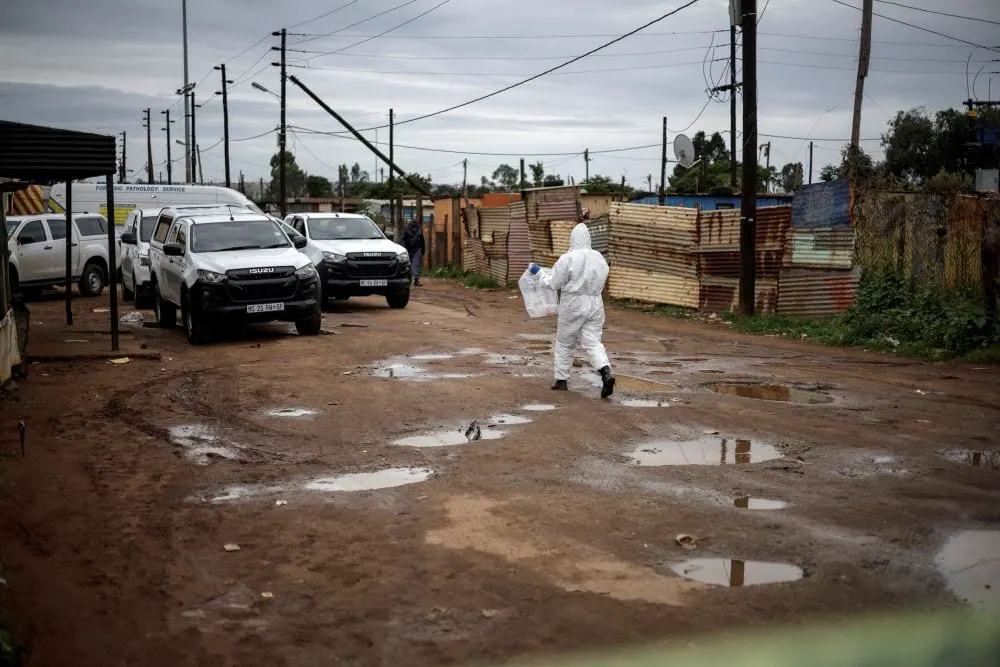
A wave of violence swept through South Africa over the weekend, leaving at least 31 people dead and 26 injured in three separate shootings. The incidents occurred at a tavern in Wedela on the West Rand, where 17 people were killed on Saturday evening, followed by 10 deaths in Lwandle in the Strand on Sunday morning, and four more in Site C, Khayelitsha. The shootings have raised concerns about the growing threat of organized crime in the country.
The Democratic Alliance (DA) has called for a stronger response to the shootings, with Ian Cameron, DA spokesperson and chair of the parliamentary portfolio committee on police, saying that South Africa cannot continue to count bodies while possibly treating organized attacks as isolated murder cases. He emphasized that investigators must look beyond the immediate perpetrators and examine possible links to organized crime, including who ordered the attacks, who paid for them, and who supplied the firearms.
According to Cameron, the Global Initiative Against Transnational Organized Crime (GI-TOC) has been warning about the threat of organized crime in South Africa for years. Research by the organization has identified a pattern of mass shootings linked to extortion, targeted killings, and access to illegal firearms and ammunition. The DA is calling for a more comprehensive approach to tackling the problem, including increased intelligence gathering and cooperation between law enforcement agencies.
Lisa Schickerling, DA spokesperson on police, echoed Cameron's concerns, saying that South Africa needs a strengthened capability in crime intelligence to infiltrate and disrupt crime networks before they strike. She also pointed to the instability at the top of the South African Police Service (SAPD) as a major concern, with the Madlanga commission having heard allegations of criminal infiltration, corruption, and political interference in the justice system.
Schickerling called for President Cyril Ramaphosa to appoint a permanent police minister with a clear mandate to stabilize the SAPD, strengthen crime intelligence, and lead an intelligence-driven offensive against organized crime networks. The DA is also demanding an immediate multi-disciplinary operation to identify and disrupt the networks behind the mass shootings, gang violence, and extortion.
The shootings have also raised concerns about the regulation of taverns and the enforcement of liquor licenses. Cameron called for stricter enforcement of regulations, including earlier closing times for taverns and the closure of businesses that repeatedly flout the conditions of their liquor licenses or municipal bylaws. He emphasized that this is not an argument against law-abiding gun owners, but rather about tackling criminal networks with access to illegal firearms and ammunition.
As the South African government struggles to respond to the growing threat of organized crime, the DA is calling for a more proactive and coordinated approach to tackling the problem. With at least 31 people killed in just one weekend, the need for effective action has never been more urgent. The government will be under pressure to deliver a more robust response to the crisis and to restore public trust in the SAPD.
Key points
- The South African government faces growing pressure to tackle the threat of organized crime following a weekend of mass shootings that left at least 31 people dead.
- The Democratic Alliance is calling for a more comprehensive approach to tackling organized crime, including increased intelligence gathering and cooperation between law enforcement agencies.
- The government has been criticized for its slow response to the crisis and its failure to appoint a permanent police minister.