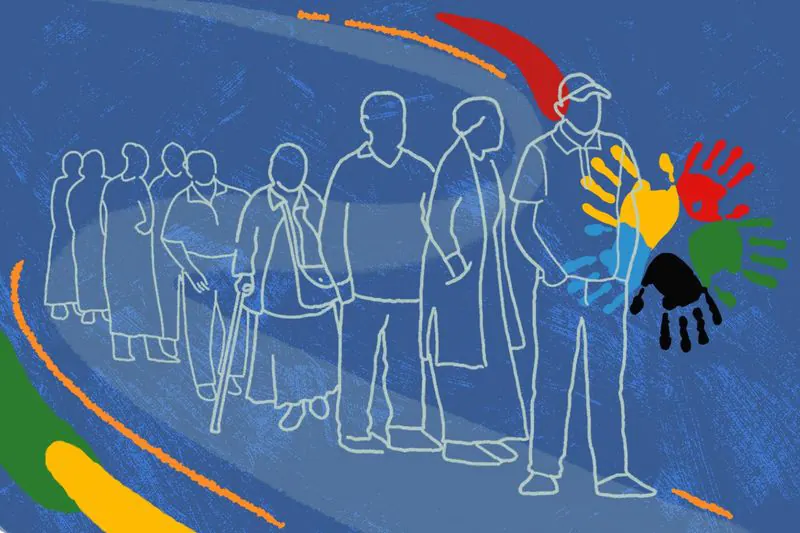
The Social Relief of Distress (SRD) grant, introduced in 2020 as a temporary measure to offset the effects of the Covid-19 lockdown, has been a lifeline for millions of people in South Africa. Six years later, the grant has become a fixture of the social assistance landscape, with approximately 7.5 million people receiving it monthly. Initially announced by President Cyril Ramaphosa on 21 April 2020 as part of a R500-billion Covid response, the grant was meant to support working-age adults without work.
The SRD grant has undergone several changes and challenges since its inception. The government initially planned to pay the grant to eight million people for six months. However, by 25 May 2020, the South African Social Security Agency (Sassa) had received about 13 million enquiries and applications, of which 6.3 million were valid and complete. The grant was extended several times during the pandemic but ended on 30 April 2021. Civil society groups campaigned for the grant to be reintroduced as a basic income grant.
The grant was reinstated in July 2021, and its administration moved under the Social Assistance Act in April 2022. This change led to a technical break in payments, with everyone having to reapply and face a monthly bank-account means test. The Department of Social Development had a R44-billion budget to reach 10.5 million people and introduced the test to keep within that amount. However, only 5.2 million people qualified under the new rules, leading to a delay in payments.
The SRD grant has also faced challenges related to fraud and verification. In October 2024, two Stellenbosch University computer science students found serious weaknesses in Sassa's online application system, which led to fraudulent SRD applications being made using ID numbers of individuals who had recently turned 18. Sassa's grant operations head, Brenton van Vrede, acknowledged the issue and advised people who believed their identities had been used to undergo biometric verification.
Researchers at the University of Cape Town's Development Policy Research Unit examined the grant's effects on employment and job-seeking using survey data from 2021 and 2022. They found that receiving the grant increased the probability that people would look for work by 3.4 percentage points and attempt to start a business by 1.5 percentage points. These effects meant that the probability of employment increased by 2.2 percentage points.
The researchers noted that the grant may ease some of the financial pressure involved in looking for work, including transport, communication, and other costs. The effect on employment was strongest in the first three months after people began receiving the grant, when their chance of finding work increased by 2.6 percentage points. However, after seven to nine months, the researchers could no longer detect a clear effect on employment.
The study's findings have implications for policy. The researchers concluded that removing the grant from the system without an equivalent substitute is likely to worsen aggregate labour market outcomes. The grant's impact on job-seeking and employment suggests that it can play a crucial role in supporting individuals in their search for work.
Key points
- The SRD grant has not discouraged people from seeking work, but rather helped them look for jobs.
- The grant's effect on employment was strongest in the first three months after people began receiving it.
- Removing the grant without an equivalent substitute could worsen labour market outcomes.