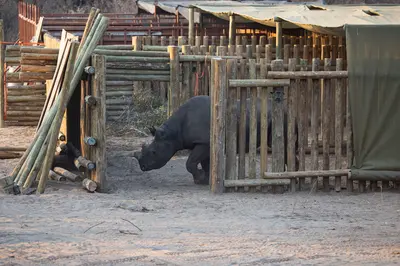
South Africa's rhino population has shown a positive trend, increasing by nearly 5% in 2025. The country's estimated minimum population of rhinos at the end of 2025 stood at 15,096, comprising 12,531 white rhinos and 2,565 black rhinos. This growth is a welcome development for conservation efforts, but the threat of poaching remains a pressing concern. According to the Department of Forestry, Fisheries and the Environment, 230 rhinos were killed by poachers in the first eight months of 2026.
The decline in poaching incidents is a notable achievement, with 230 rhinos killed nationally between January and August 2026, compared to 248 in the same period last year. The Kruger National Park, a hotspot for poaching, saw a decline in incidents, with 114 rhinos poached during the period, down from 123 in the corresponding period last year. KwaZulu-Natal also recorded a sharper decline, with 29 rhinos poached in the first eight months of 2026, compared to 67 in the same period last year.
However, poaching increased in several other provinces, including Mpumalanga and North West. In Mpumalanga, 14 rhinos were killed compared to three in 2025, while North West recorded 19 compared to 14. The Department of Forestry, Fisheries and the Environment attributed the decline in poaching to continued dehorning, maintenance, and strengthened protection and law enforcement measures.
The country's efforts to rebuild rhino populations extend beyond its borders. The World Wildlife Fund South Africa's (WWF-SA) Black Rhino Range Expansion Programme has successfully translocated 20 black rhinos from KwaZulu-Natal to Botswana. This move effectively doubles Botswana's black rhino population, which was estimated to be around 25 before the translocation.
The translocation, which took place in early September, was a complex operation that involved capturing the rhinos in June and holding them in quarantine. The rhinos were then moved in two 36-hour road trips to a remote and secure site in Botswana. According to Jeff Cooke, the programme's leader, finding sufficiently large areas of suitable habitat for black rhinos is becoming increasingly difficult, prompting the programme to expand its work into neighbouring countries.
The national integrated strategy to combat wildlife trafficking has also shown progress, particularly in coordinated investigations, prosecutions, intelligence sharing, and targeted operations. One notable case is that of Dawie Groenewald, who was sentenced to fines exceeding R10 million and prison terms totalling 36 years for his role in a large-scale rhino horn trafficking enterprise.
The Department of Forestry, Fisheries and the Environment emphasized that the fight against rhino poaching requires cooperation between conservation authorities, law-enforcement and criminal justice agencies, government, financial institutions, communities, the private sector, and international partners. South Africa's 10-year biodiversity management plan for black and white rhinos aims to grow and secure rhino populations through biological management and support for population expansion projects.
Key points
- South Africa's rhino population increased by 5% in 2025, but 230 rhinos were killed by poachers in the first eight months of 2026.
- The country has seen a decline in poaching incidents, but the threat remains a pressing concern.
- Conservation efforts, including translocation programmes and law enforcement, are underway to protect the rhino population.