The outcome of South Africa's recent municipal elections has raised concerns about the country's ability to implement much-needed economic reforms and repairs. The African National Congress's (ANC) national support fell to 31%, while the Democratic Alliance (DA) received 25%. In Gauteng, the DA emerged as the largest party in Johannesburg, Tshwane, and Ekurhuleni, but coalition arrangements may exclude them from governing in these metros.
The elections delivered a clear message that the status quo is no longer acceptable, but the emerging coalition arrangements have disappointed some, as they appear to prioritize party advantage over competent government and economic reconstruction. The negotiations have been influenced by disagreements between the DA and ActionSA over mayoral candidates, contributing to the breakdown in their talks.
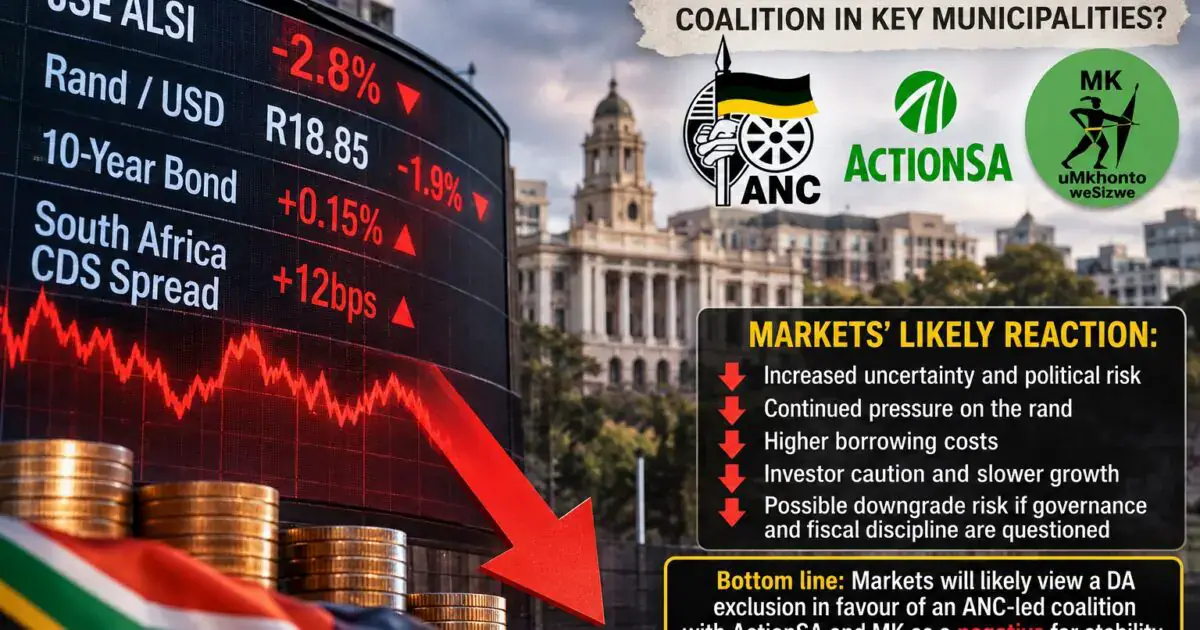
Financial markets have taken notice of the political uncertainty, with the rand falling sharply in the week after the elections and breaching R17 to the dollar. However, it would be wrong to attribute every movement in the currency to politics, as global risk appetite, US interest-rate expectations, and the dollar also play a significant role.
The ANC is correct that financial markets have no right to dictate coalition negotiations, but investors have their own ballot box, deciding whether to buy bonds, hold currency, build factories, or take capital elsewhere. Governments are free to make political choices, but they are not free to choose the economic consequences.
South Africa's challenge is different from the one it faced in the early 1990s, when it transitioned to democracy. Today, the country needs to repair the machinery of its economy, which is visible in deteriorating public infrastructure, potholes, broken traffic lights, water interruptions, and sewage spills.
To address these challenges, South Africa needs reliable electricity, better logistics, functioning water infrastructure, capable municipalities, and an environment in which businesses have enough confidence to employ people and invest. The question is whether politics will accelerate this process or get in its way.
The municipal elections offered a chance for political leaders to demonstrate their understanding of the urgency of the moment, but hope is not an economic strategy. The electorate and markets are sending messages, and it remains to be seen whether political leaders will respond effectively to these signals.
Key points
- The delay in implementing economic reforms and repairs could have severe consequences for South Africa's growth and development.
- The country's political uncertainty may hinder its ability to attract investment and create jobs.
- The electorate's message and market signals highlight the need for competent government and economic reconstruction in South Africa.
Reporting sources
- Can SA afford to waste another five years? · Jewish Report