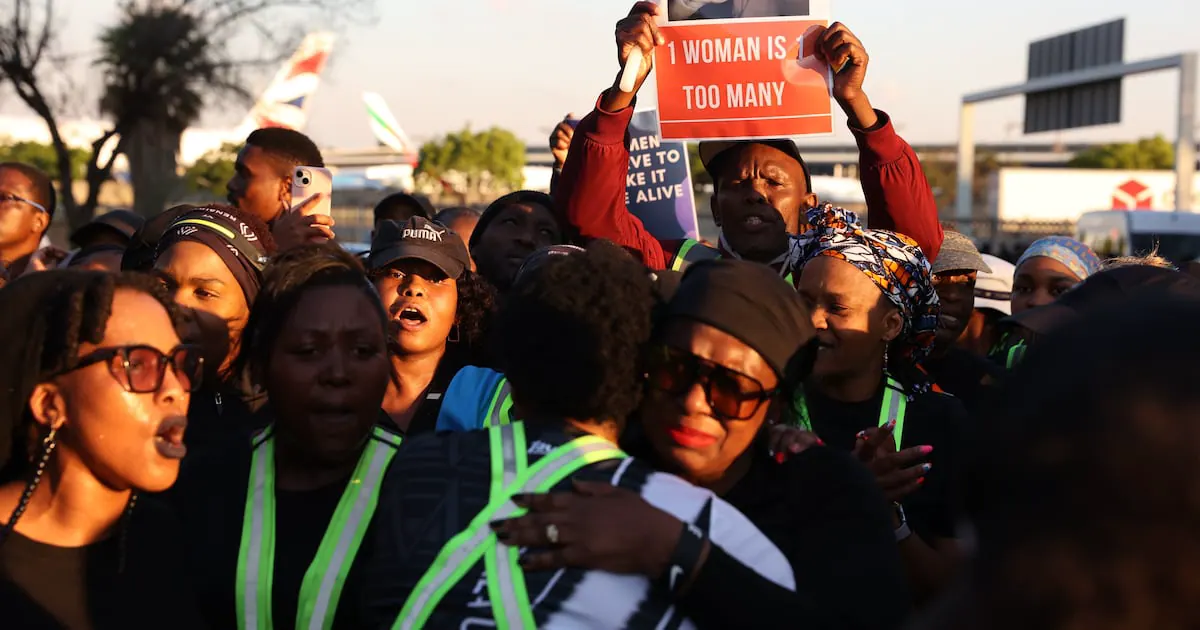
A string of brutal attacks in Ekhurhuleni has led to the grim discovery of nine women's bodies since mid-July, prompting nationwide protests, widespread media coverage, and international condemnation. The incidents have sparked outrage, with South Africans rightly angry about the country's horrific level of violence against women. This recent surge in violence has brought attention to the risks women face when venturing out alone, with running clubs organizing events in memory of Elizabeth "Tsontso" Moselakgomo, who was murdered while on a run.
This is not the first time South Africa has faced widespread outrage over violence against women. In 2019, the rape and murder of UCT student Uyinene Mrwetyana led to thousands of women marching in protest and starting a social media campaign hashtagged "am I next". The campaign put pressure on the government to do more to address the issue. Last November, the Women for Change movement organized nationwide demonstrations against gender-based violence, with thousands of protesters mobilizing and wearing black, staging a silent "lie down" for lives lost, and running an online petition that garnered over a million signatures.
In response to the growing concern, the government declared gender-based violence a national disaster last year, promising more resources and an intensified effort to make things better. However, according to the Human Sciences Research Council (HSRC), a third (33.1%) of women over the age of 18 have faced physical violence, and 9.8% have experienced sexual violence. The statistics highlight the need for more effective action to address the issue.
The HSRC also reports that more than a fifth of South African women (22.4%) have experienced intimate partner violence. Furthermore, the digital world is not safe for women, with a pervasive culture of technology-facilitated gender-based violence aimed at silencing and intimidating women journalists in the region, according to the Media Institute of Southern Africa. The "manosphere" – online communities that promote the idea that wealth, emotional control, and dominance over women are indicators of male worth – also poses a significant threat.
Despite the government's declaration of a national disaster, there is still a lack of tangible results for women and girls. The classification did not automatically release emergency funding but gave Treasury the power to reprioritize existing budgets. However, there was scant evidence of that in the 2026 budget, which simply allocated an additional R136m over the medium term to the national council on gender-based violence to step up government coordination.
The United Nations has urged the government to translate its promises into tangible results for women and girls. South Africa's women need the government to turn its declarations into functioning institutions, with properly resourced police, an effective justice system, and sustained support for survivors. The government must take concrete actions to address the issue, rather than simply repeating promises.
Ultimately, South Africa's women don't need another round of outrage, promises, and inaction. They need the government to take concrete actions to address the issue. The cycle of violence will continue unless the government takes decisive action to create a safer environment for women. The international community is watching, and it is up to the government to demonstrate its commitment to change.
Key points
- The government declared gender-based violence a national disaster last year, but there is still a lack of tangible results for women and girls.
- According to the HSRC, a third (33.1%) of women over the age of 18 have faced physical violence, and 9.8% have experienced sexual violence.
- The government allocated an additional R136m over the medium term to the national council on gender-based violence to step up government coordination.