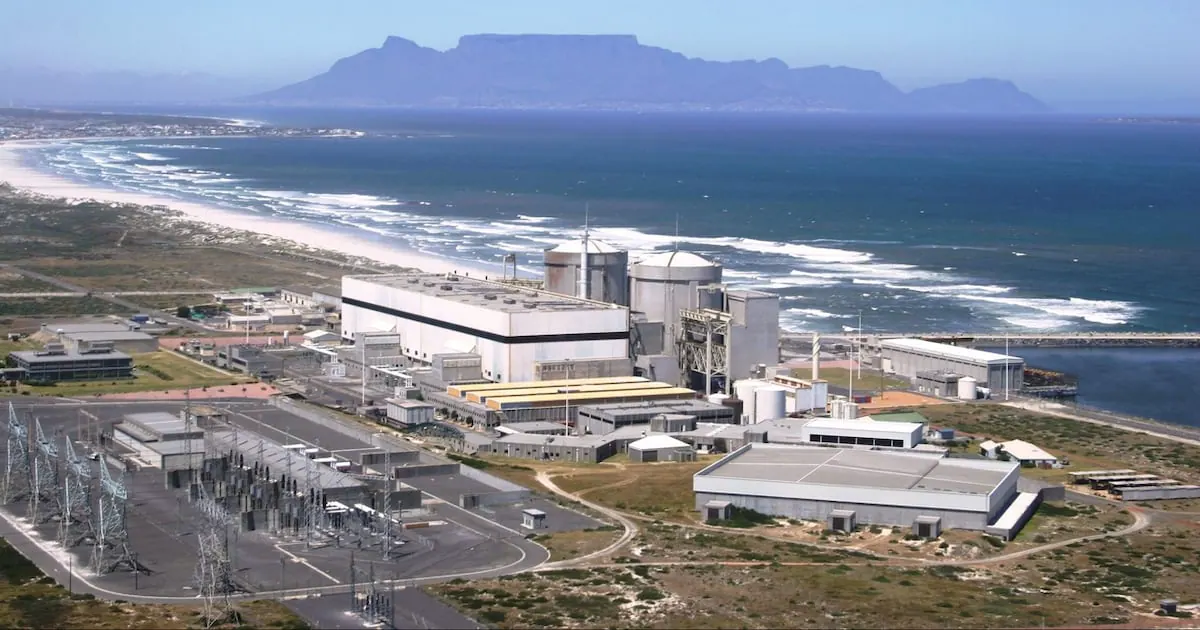
A tour of Koeberg, Africa's only nuclear power station, reveals the intricate workings of this engineering feat, which has been safely and reliably operated by Eskom for over 40 years. Located near Cape Town, the plant was built in the 1970s to address the expensive and inefficient transportation of coal across the country to the region. With a total capacity of 1,940MW, Koeberg meets about half of the Western Cape's electricity requirements. The plant's longevity and reliability have made it a valuable asset for Eskom, which is now considering extending its life to 80 years.
Eskom's chief nuclear officer, Velaphi Ntuli, emphasizes the importance of nuclear technology in South Africa's energy mix, citing the need to move beyond isolated incidents and consider the technology as a whole. Ntuli, appointed last year, is expected to play a leading role in the country's new nuclear build, the first since Koeberg. He encourages dialogue between proponents and detractors of nuclear power, stressing that most criticism is based on fear and that understanding the benefits of nuclear energy is crucial. Eskom has committed to operating Koeberg safely and reliably, and Ntuli is confident in the company's ability to do so.
The nuclear industry has faced criticism in South Africa, with opponents citing the costs and delays associated with building such plants, as well as the potential for catastrophic incidents. However, Ntuli and others argue that nuclear power can be a stable source of energy, and that the benefits outweigh the risks. As Eskom looks to build new nuclear capacity, the company is drawing on the expertise developed at Koeberg, where approximately 1,500 people work, representing some of the country's finest engineering and scientific talent. The demographics of Koeberg have shifted over the years, with more women and people of colour taking up leadership roles.
The skills developed by Eskom at Koeberg have not gone unnoticed, with international firms poaching South African talent. Eskom's nuclear new-build senior manager, Sadika Touffie, acknowledges that the exodus of talent to overseas markets is a natural consequence of global competition for skilled professionals. However, Touffie is confident that the talent pool and expertise developed at Koeberg will be sufficient to support future nuclear builds, including the planned 5,200MW of new nuclear capacity by 2039. The integrated resource plan outlined last year emphasizes the need for localization, skills transfer, and supplier development.
Prof Bismark Tyobeka, principal and vice-chancellor of North-West University, stresses the importance of rebuilding South African engineering capacity through nuclear construction. He notes that a new nuclear program provides an opportunity to develop local skills, including civil, mechanical, electrical, and nuclear engineers, as well as materials specialists, technicians, and manufacturers. Tyobeka cites the pebble bed modular reactor program as an example of South Africa's capabilities in nuclear engineering and emphasizes the need for a deliberate approach to skills development and industrial capacity building.
A study commissioned by Eskom has recommended Thyspunt, a stretch of coast in the Eastern Cape, as the site for the proposed new nuclear plant, with Cape Town as the other option. However, environmental groups are mobilizing resources for a legal battle to block the 5,200MW nuclear plant, citing concerns about the environmental impact. The Thyspunt Alliance, a coalition of civic, conservation, and other organizations, argues that the economic benefits of the plant do not outweigh the potential environmental costs. This challenge could delay the project for years, adding uncertainty to Eskom's plans.
As South Africa prepares for its new nuclear build, Eskom is laying the groundwork for a business case to extend Koeberg's life for a further 20 years beyond 2045. The company's efforts to retain homegrown skills and expertise will be crucial in supporting future nuclear projects, both domestically and internationally. With other African countries, such as Egypt, Kenya, and Nigeria, looking to develop nuclear power capacity, Koeberg offers valuable lessons and a model for their own programs. Eskom's experience and expertise will be essential in shaping the future of nuclear energy in Africa.
Key points
- Eskom considers extending Koeberg nuclear power plant's life to 80 years.
- South Africa plans to build 5,200MW of new nuclear capacity by 2039.
- Localization, skills transfer, and supplier development are crucial for South Africa's nuclear program.