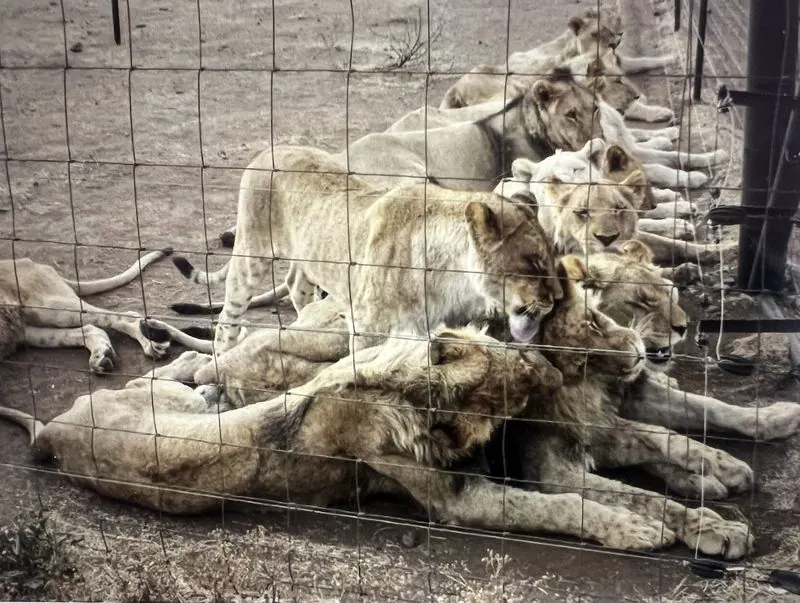
For years, South Africa authorized the commercial export of captive-bred lion skeletons to Asian markets, but a recent parliamentary reply reveals that the government never conducted a retrospective assessment of the policy's consequences. The trade emerged in the late 2000s, combining the country's large captive-lion breeding sector with East and Southeast Asian markets for big cat derivatives. The first CITES permits for lion bone exports were issued in 2008, with Laos and Vietnam as primary destinations.
Between 2008 and 2015, South Africa issued permits covering over 5,300 skeletons destined for East and Southeast Asia. Research estimates that more than 6,000 skeletons, weighing at least 70 tonnes, were shipped from Africa to the region since 2008. The trade developed into a significant commercial stream, with lion bone entering markets historically associated with tiger products, including medicinal preparations and tonics. Lion bone increasingly functioned as a substitute or supplementary source as international controls on tiger trade tightened.
The Department of Forestry, Fisheries and the Environment (DFFE) confirmed that it has not undertaken a separate retrospective evaluation of the consequences of the historical export of captive-bred lion skeletons. Moreover, the DFFE states that it has never conducted a specific market-demand or consumer-behaviour study to determine whether South Africa's authorised exports established or expanded international demand for lion derivatives. The government claims that CITES did not require such a market-demand study before Appendix II exports could be authorised.
However, academic research had already identified concerns about the lion bone trade. Researchers warned about potential laundering, misdeclaration, and the relationship between legal and illegal markets for large-cat derivatives. The DFFE points to the lion non-detriment finding, which concluded that South Africa's wild lion population was stable and that legal international trade posed a non-detrimental risk to the survival of the species. However, this finding does not address the impact of the trade on consumer behaviour, price, substitution between species, or laundering opportunities.
The captive-breeding industry has defended itself, claiming that supplying hunters and derivative markets with farmed lions reduces pressure on wild populations. However, evidence suggests that wild lions are being deliberately targeted for their body parts, including inside Kruger National Park. The South African National Biodiversity Institute's (Sanbi) 2026 supporting assessment for the lion non-detriment finding records an increase in lion poaching in northern Kruger, with many incidents involving the removal of body parts.
The Endangered Wildlife Trust reports multiple lion-poaching incidents at Dinokeng Game Reserve in Gauteng since 2020, several of which involved the removal of body parts. SANParks confirmed that 72 Kruger lions have been illegally killed since 2017 – 37 poisoned and 35 snared. These findings raise concerns about the effectiveness of the government's approach to regulating the lion bone trade and its impact on wild lion populations.
The South African government has since maintained a zero commercial export quota for lion bones, following a 2019 Gauteng High Court judgment that set aside previous quota decisions as unlawful and constitutionally invalid. While the trade may have stopped legally, its consequences are still unclear and potentially far-reaching. The government's failure to study the impact of the trade on wild lions and international demand raises questions about its commitment to responsible environmental governance.
Key points
- The South African government never conducted a study on the impact of exporting captive-bred lion skeletons on wild lions and international demand.
- The lion bone trade has been linked to an increase in lion poaching in Kruger National Park and other areas.
- The government's approach to regulating the lion bone trade has been criticized for prioritizing CITES compliance over responsible environmental governance.