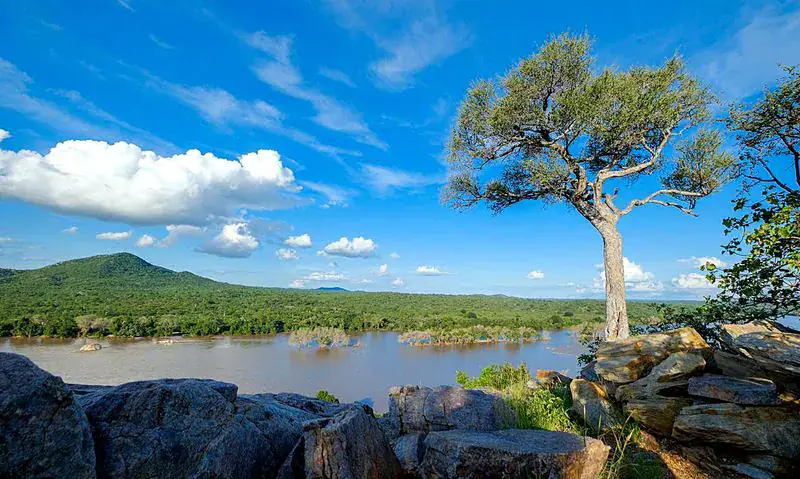
A massive Chinese industrial development in the Limpopo province of South Africa has sparked concerns about its potential environmental impact. The project, led by the Chinese-controlled Kinetic Development Group, involves the construction of coal pits, coke ovens, power generation facilities, and smelters in the Musina-Makhado Special Economic Zone (SEZ). The development is planned for a beautiful Bushveld biosphere reserve, which is a protected area known for its unique biodiversity.
The project has raised concerns about water scarcity in the region, as the Limpopo River, which flows through the area, periodically runs low. The Department of Water and Sanitation has reported that the reliable and sustainable water supply needed to support the industrial development is unproven. Despite this, construction has begun on the Makhado mine, which is the first mine in the industrial chain. Environmental groups have objected to the project, citing concerns about the impact on the water supply and the environment.
The proposed industrial complex is expected to have a significant impact on the environment, including the destruction of wildlife habitats and the disruption of water catchments. The development will also affect communities that rely on groundwater, which is a vital resource in the region. Environmental groups have argued that the cumulative impact of the development has not been properly assessed and that the project is being presented as a series of separate applications rather than a single, integrated project.
The project has been driven by a Framework Agreement on China-South Africa Production Capacity Cooperation, which aims to offshore surplus capacity in steel production from China to South Africa. The development is also seen as a way for China to further its Belt and Road Initiative in Africa. However, environmental groups have argued that the project is not in line with South Africa's commitments to reduce its carbon pollution and that it will have significant long-term effects on the environment.
The environmental impact assessment for the project has been criticized for omitting key information, including combustion emissions from the coke ovens. The assessment has also been criticized for underestimating the project's greenhouse gas emissions, which are projected to be 33 million tons per year. Environmental groups have called for a more comprehensive assessment of the project's impact and for the government to take a more active role in regulating the development.
The project has also raised concerns about the role of the national government in regulating the development. The Department of Forestry, Fisheries and the Environment has been criticized for failing to intervene in the project, despite concerns about its environmental impact. The department has argued that environmental decision-making rests with the provincial government, but environmental groups have argued that the national government has a critical role to play in regulating the development.
The development is expected to have significant economic benefits for the region, but environmental groups have argued that these benefits come at a significant environmental cost. The project is seen as a test of South Africa's commitment to environmental protection and its ability to balance economic development with environmental sustainability. The outcome of the project is likely to have significant implications for the country's environmental policies and its relationships with international partners.
Key points
- The proposed industrial complex in Limpopo province has raised concerns about water scarcity and environmental impact.
- The project has been driven by a Framework Agreement on China-South Africa Production Capacity Cooperation.
- Environmental groups have criticized the project's environmental impact assessment for omitting key information and underestimating greenhouse gas emissions.