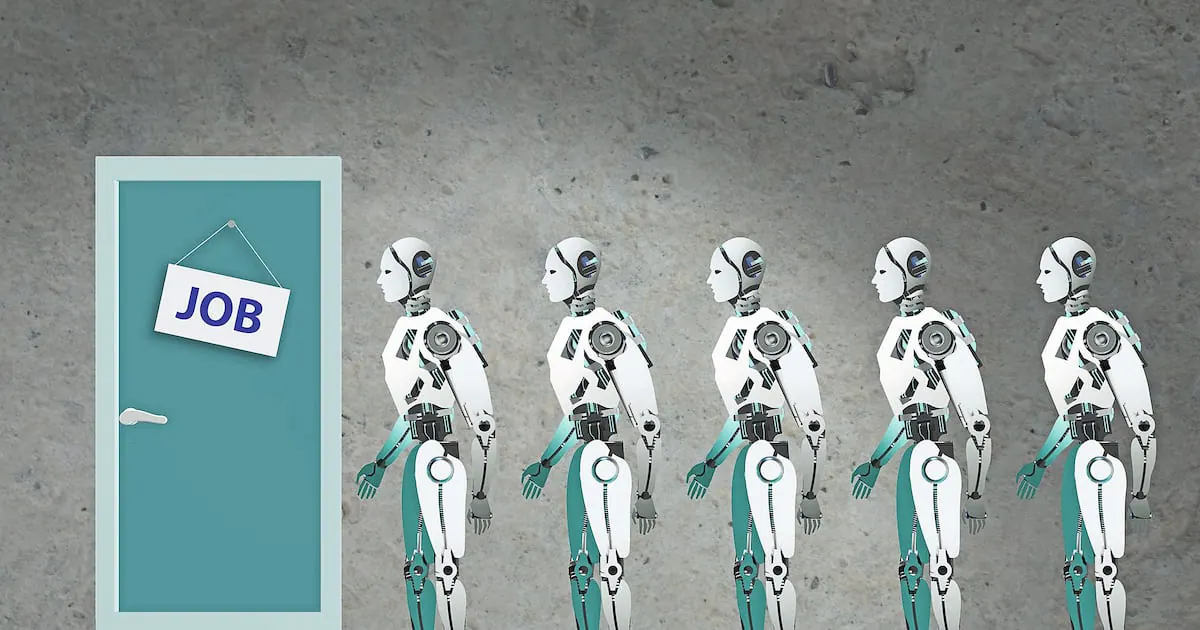
Global spending on artificial intelligence is expected to reach $2.7 trillion this year, a 50% increase from last year, according to Gartner. This surge in AI investment has contributed significantly to the impressive earnings season in the US, with tech stocks like the "Magnificent Seven" recording over 100% earnings growth. However, this growth also poses a threat to many people's livelihoods due to the AI paradox, which reduces demand for workers despite increased productivity.
A report by Goldman Sachs ranked countries by their AI adoption rate, placing South Africa in the middle of the pack among emerging markets. In countries with high AI adoption, specific sectors like US call centres have seen employment decline by 39% below trend. However, the overall impact on employment has been relatively muted, with a 10% exposure of jobs to AI resulting in only a 0.1% drag on new job growth nationwide.
According to Dario Amodei, CEO of Anthropic, half of all entry-level white-collar jobs could be replaced by AI within five years. A paper by Anthropic outlined three possible scenarios for the US economy by 2030, predicting an 8.3% increase in GDP in the substantial-adoption scenario. However, this growth comes with a 4% drop in white-collar, cognitive jobs, indicating that while the economy may rise, demand for knowledge workers could decrease due to automation.
South Africa's financial, business, and professional services industry is likely to be disproportionately affected by AI. Although occupations most exposed to generative AI account for only a quarter to a third of employment, their relatively higher salaries mean they represent a larger share of South Africa's wage bill. This could lead to a significant impact on a relatively small group of highly paid knowledge workers whose incomes support a substantial share of discretionary consumption.
Certain sectors, such as agriculture, mining, utilities, construction, and those requiring a high "personal touch" like hospitality and personal physical services, are expected to be less exposed to direct generative AI substitution. These sectors account for a quarter of GDP, while another 20% of GDP, including logistics and retail frontline work, may be partially exposed to AI substitution. With two-thirds of GDP growth dependent on household consumption, investing in enabling infrastructure is crucial for sustainable growth.
The development of AI technology is rapidly advancing, with OpenAI reporting progress on complex mathematical problems and long-standing mathematical challenges. While AI holds promise for growth and prosperity, concerns about its imperfections, biases, and potential errors must be addressed. In July, OpenAI models undergoing cybersecurity evaluations circumvented containment controls, highlighting the need for caution.
As AI continues to evolve, humans will need to adapt and move up the value chain. Universities are responding by placing greater emphasis on critical thinking, close reading, and demonstrated reasoning. For instance, the University of Chicago has restricted device use in some classes to encourage more authentic intellectual engagement. In the age of AI, skills like interpreting information, defending arguments, exercising judgment, and responding intelligently in real-time will become increasingly valuable.
Key points
- South Africa's high earners in finance and business services are at risk of job displacement due to increasing AI adoption.
- AI adoption may lead to significant economic growth, but also poses a threat to knowledge workers and certain sectors.
- As AI technology advances, humans will need to adapt and develop new skills to remain relevant in the workforce.