South Africa, a signatory to the 2015 Paris Agreement, has set targets for greenhouse gas emissions to limit global warming to 1.5°C-2°C above pre-industrial levels. However, the Climate Action Tracker has rated the country's targets as "insufficient", warning that if all countries followed the same approach, global warming would exceed 2°C and potentially reach 3°C. The tracker suggests that South Africa should reduce its emissions by 40% between 2022 and 2035 to do its fair share in limiting warming to 1.5°C.
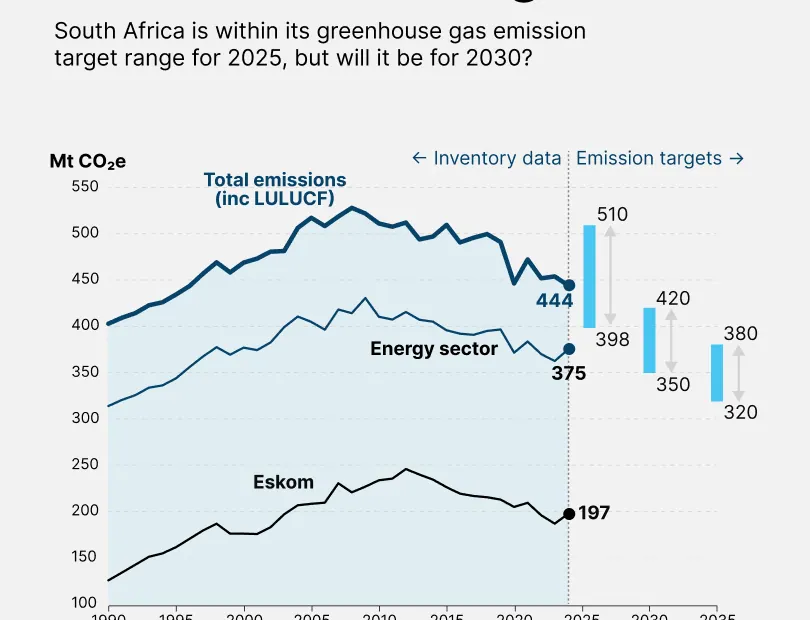
According to the latest draft national inventory, South Africa's estimated net 2024 greenhouse gas emissions are approximately 444 million tonnes. This is within the range of the 2025 targets, which represent a 16% to 29% cut from 2008 levels. The country's emissions peaked in 2008 and have been decreasing unevenly since, largely due to economic stagnation and load shedding. However, with load shedding easing in 2024, energy sector emissions have increased as Eskom burned more coal.
The energy sector alone emitted 375 million tonnes in 2024, exceeding the lower target for 2030 of 350 million tonnes. To reach the top of the 2030 range, emissions must fall by another 24 million tonnes, while a reduction of 94 million tonnes is needed to reach the bottom of the range. The government's electricity plan, the IRP 2025, aims to retire 8GW of coal by 2030, but this is contingent on 6GW of new gas power being operational by then, which is uncertain.
Research by the University of Cape Town, commissioned by the government, found that implementing existing policies, including the Renewable Energy Masterplan, could bring emissions to between 289 million tonnes and 359 million tonnes by 2035. This is in line with the lower end of the 2035 target of 320 million tonnes. Analysts argue that the targets are unambitious and can be achieved without further effort.
Critics argue that the targets are too easy and do not require significant action from industry and government. Déna Jansen, an analyst at Just Share, stated that "the targets are so unambitious that we could hit them by doing what industry and government have already promised to do, without lifting a finger further". She added that the upper end of the 2035 target, 380 million tonnes, "is what tends to become the real operating target in practice".
If South Africa fails to demonstrate its commitment to transitioning to clean energy, the country risks losing access to international finance and may face carbon taxes from importing countries. Jansen emphasized that a target that does not require significant action is merely a formality. The country's ability to meet its emissions targets will be closely watched by international observers.
The South African government faces pressure to increase its climate ambitions and demonstrate a commitment to reducing greenhouse gas emissions. With the country's emissions targets under scrutiny, the government must balance its economic development needs with the imperative to address climate change. The outcome will have significant implications for South Africa's energy sector and its role in the global effort to combat climate change.
Key points
- South Africa's greenhouse gas emissions targets have been rated as "insufficient" by the Climate Action Tracker.
- The country's emissions peaked in 2008 and have been decreasing unevenly since, largely due to economic stagnation and load shedding.
- Critics argue that the targets are too easy and do not require significant action from industry and government.