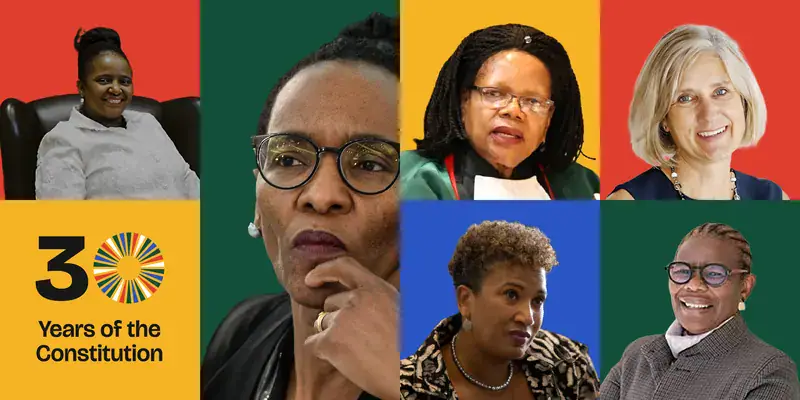
South Africa's Constitutional Court has made history with a female majority on its permanent Bench for the first time since its establishment in 1994. In May 2026, six women justices sat on the court, led by Chief Justice Mandisa Maya, the first woman to occupy South Africa's highest judicial office. This milestone represents a remarkable transformation of an institution entrusted with defending constitutional principles of equality, dignity, and freedom.
Chief Justice Mandisa Maya has been a trailblazer in her career, becoming the first woman president of the Supreme Court of Appeal in 2017 and then South Africa's first female chief justice in September 2024. Her judicial work has addressed constitutional accountability, electoral law, and the exercise of public power. Maya has also championed women's advancement in the judiciary through the International Association of Women Judges.
Nonkosi Mhlantla, another justice on the Constitutional Court, has authored significant judgments on criminal justice, equality, and the interpretation of legislation affecting vulnerable communities. In May 2025, Mhlantla authored the judgment in Blind SA v President of the Republic of South Africa, which concerned the rights of blind and print-disabled people to access books and other copyrighted material in formats they could use.
Leona Theron, the first coloured woman justice on the Constitutional Court, has encompassed criminal procedure, administrative fairness, and constitutional rights in her judicial career. In Mutsila v Municipal Gratuity Fund, decided in August 2025, Theron authored a unanimous judgment concerning the distribution of pension death benefits. The case arose after a municipal employee died in a workplace accident, leaving a widow and children whose financial security depended partly on the pension fund's decisions.
Zukisa Tshiqi, who retired in May 2026 after more than two decades on the Bench, authored significant judgments, including Sithole v Sithole in 2021, which challenged apartheid-era matrimonial-property legislation that discriminated against black women married before 1988. Tshiqi also authored the landmark 2025 Van Wyk judgment, which found unequal parental-leave provisions unconstitutional and established a framework allowing parents to share leave.
Nambitha Dambuza-Mayosi and Katharine Savage were appointed to the Constitutional Court in May 2026, bringing extensive experience in commercial, competition, and constitutional law. Dambuza-Mayosi authored the unanimous judgment in GD v Minister of Home Affairs, declaring section 7(7)(c) of the Divorce Act unconstitutional. The provision discriminated between women married before and after November 1984 under certain matrimonial-property arrangements.
The milestone of a female majority on the Constitutional Court marks a significant shift in the country's highest judicial institution. The justices have delivered judgments that advance equality, dignity, freedom, and justice, demonstrating their commitment to upholding the constitutional principles of South Africa. The court continues to play a crucial role in shaping the country's laws and protecting the rights of its citizens.
Key points
- The Constitutional Court of South Africa has achieved a historic milestone with a female majority on its Bench, marking a significant shift in the country's highest judicial institution.