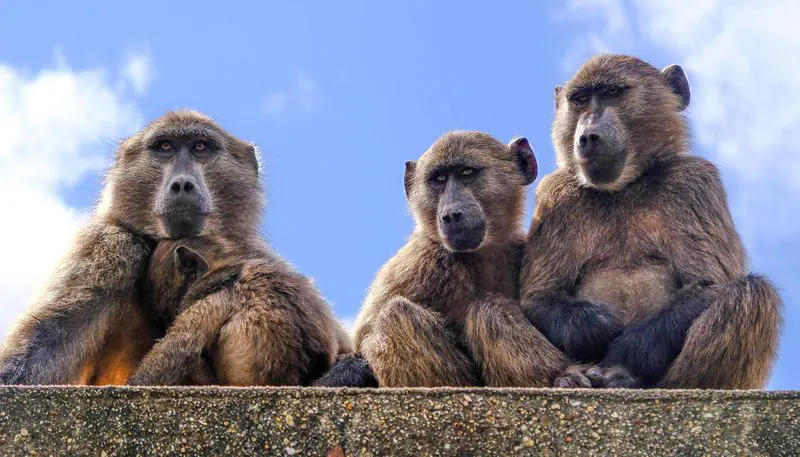
The town of Simon's Town in South Africa is grappling with a contentious issue regarding its baboon population. The City of Cape Town plans to relocate the Waterfall troop to a fenced area at the Urban Wildlife Centre in Kogelfontein, a move opposed by some residents. Demonstrations and protests have erupted, with pro-stay groups and officials on opposite sides of the debate. The issue is a classic example of a "wicked problem," resisting clear definition and tidy solutions.
University of Cape Town Professor Justin O'Riain has been studying the Waterfall troop and suggests that the solution lies in a simple question: where to put the fence. He advocates for the Urban Wildlife Centre, citing years of research on the troop's behavior. O'Riain believes that a sanctuary can provide a safe and suitable environment for the baboons, guaranteeing relief for both residents and animals. His research has shown that the baboons are drawn to human food and shelter, leading to hazardous urban excursions.
O'Riain acknowledges that the proposed facility is a political compromise, shaped by opposition to euthanasia. He notes that the sequence of events has been chaotic, with protests against killing the baboons, followed by demands to let them live, and then protests against the sanctuary. He questions what alternative solutions those opposed to captivity have to offer. O'Riain is confident that the City will continue to provide care for the baboons over the next 20 or 30 years.
Researcher Dr David Gaynor disagrees with O'Riain's solution, advocating for a fence above Simon's Town instead of relocation. He has secured funding for the project and argues that an urban boundary can keep the Waterfall and Seaforth troops wild while protecting residents. Gaynor also wants to assess the genetic consequences of removal, suggesting that losing the two troops could reduce the effective genetic size of the Southern Peninsula's wild baboon population.
Anthropologist Samantha Hurn's research highlights the complexity of the issue, with conservation authorities, scientists, welfare groups, and residents divided on what a baboon represents. The debate centers not only on what works but also on what a baboon is – a wild animal, troublesome neighbor, protected wildlife, or something approaching a fellow citizen. This fundamental disagreement contributes to the challenge of finding a solution.
A 2017 study by Gaelle Fehlmann, O'Riain, and colleagues found that urban areas provide roughly 10 times more energy per bite than food in the natural environment. This has radically altered the behavior of the baboons, with raiding males spending only 9.5% of their time foraging. O'Riain notes that towns have become baboon fast-food outlets, making it difficult for them to adapt to their natural environment.
As the debate continues, the fate of the Waterfall troop remains uncertain. While some scientists and officials advocate for relocation, others propose alternative solutions such as fencing. The issue highlights the need for a comprehensive and multi-faceted approach to managing the baboon population in Simon's Town, balancing the needs of both residents and animals.
Key points
- The City of Cape Town plans to relocate the Waterfall troop to a fenced area at the Urban Wildlife Centre in Kogelfontein.
- Scientists and residents are divided on the best solution for managing the baboon population in Simon's Town.
- The debate centers on balancing the needs of both residents and animals, with no clear solution in sight.