The 2026 local government elections in South Africa have brought about a significant shift in the country's political landscape. The ANC's loss of absolute majorities in metropolitan municipalities has been a sobering historical rupture for the party and its faithful. This shift cannot be solely attributed to changing party fortunes, rising coalitions, or voter fatigue. Rather, it is a symptom of a deeper, unhealed pathology: continued spatial injustice. The election results illuminate the stark reality of spatial injustice and inequality in South Africa.
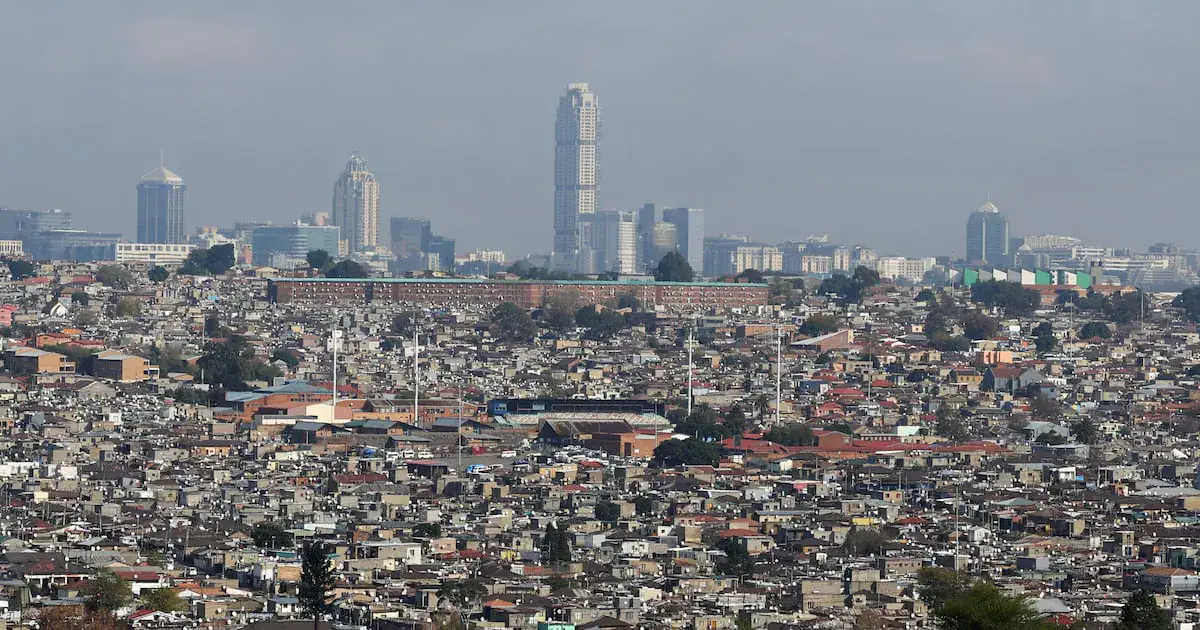
The geography of South Africa's settlements tells a more permanent story than the ephemeral nature of elections. The Lehohla Ledger, a diagnostic architecture developed by Pali Lehohla, forces us to look past aggregate municipal averages and examine the granular mesh of settlements. It maps out how apartheid's engineered geography has survived the democratic transition and, in many ways, metastasized. The infamous 75-metre divide across the M1 highway separating Alexandra from Sandton is a textbook microcosm of this spatial apartheid.
The mathematical fingerprint of apartheid's ghost is evident in the behaviour of Moran's I, the statistical measure of spatial autocorrelation. An increasing Moran's I indicates that poverty and wealth in South Africa are becoming increasingly clustered and entrenched. Instead of post-apartheid urban planning diffusing development and integrating historically segregated spaces, metro areas are hardening into hyper-segregated enclaves. Wealth clusters tightly with wealth, and destitution clusters intensely with destitution.
When spatial injustice deepens, democracy ceases to be viewed as an instrument of transformation and is instead experienced as an empty ritual. As Moran's I ticks upward, it locks spatial injustice into the physical layout of cities. When public goods, municipal revenue, and infrastructural investment follow historical lines of privilege, the social contract frays. For the ANC, which built its legitimacy on the promise of a united, non-racial, and equitable society, this increasing spatial polarisation acts as an unyielding political indictment.
The 2026 results, marked by the loss of the ANC's majority and the proliferation of fragmented municipal councils, mean that South Africa has entered an era of complex coalition governance. For disappointed ANC loyalists, the immediate instinct is to look for tactical missteps, leadership errors, or external interference. However, the Ledger suggests that tinkering with political coalitions or changing executive mayors will yield little change if the underlying spatial economy remains untouched.
In "High-High" poverty clusters, voters have moved decisively away from traditional loyalties. In some wards, protest parties and radical economic formations capitalised on the rage of the unmapped and unserved; in others, profound voter apathy signalled a quiet secession from the ballot box, with citizens seeking autonomous survival strategies entirely outside the state. The rising Moran's I measures the physical distance between the ruling party's liberation promises and the inescapable, concrete reality of the township periphery.
If the 2026 local government elections teach us anything, it is that political power without spatial restructuring is hollow. Winning a plurality or cobbling together a fragile, short-lived municipal coalition is no longer enough when the underlying geography is structurally insolvent. To honour the sacrifices of South Africa's history and address the genuine grief of voters who watched their historic movement lose its grip on the majority, the country's political leadership must look into the data and commit to a generational commitment to spatial justice guided by rigorous empirical instruments.
Key points
- The 2026 municipal elections in South Africa have exposed deep-seated spatial injustice and inequality, which are becoming increasingly entrenched.
- The ANC's loss of absolute majorities in metropolitan municipalities is a symptom of a deeper, unhealed pathology: continued spatial injustice.
- Spatial restructuring is necessary to address the structural inequality and poverty that are reproducing themselves faster than political parties can adapt to them.