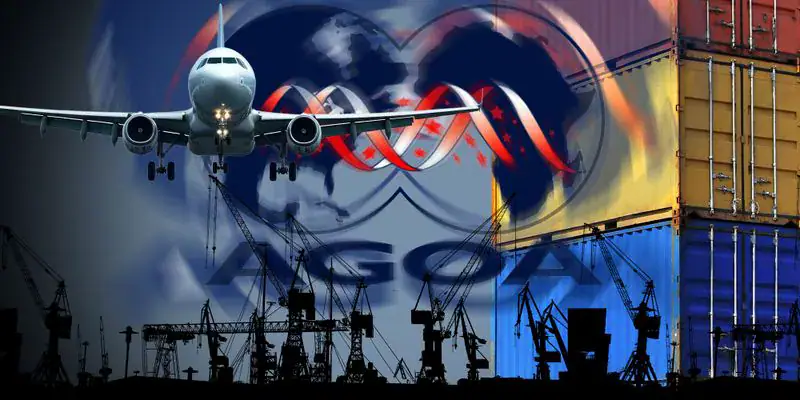
The US government announced on Monday that South Africa will be removed from the African Growth and Opportunity Act (Agoa) duty-free benefits from next year. This decision was made after the South African government "constructively responded" to US concerns. The US trade representative, Jamieson Greer, stated that President Donald Trump decided to remove South Africa due to practices inconsistent with Agoa's eligibility criteria, including barriers to US trade and investment, corruption, and threats to US national security and foreign policy interests.
The removal from Agoa has raised concerns among various stakeholders in South Africa. Citrus farmers have called it "a serious blow to the citrus industry," while Cosatu expressed deep concern over the impact on thousands of agricultural and manufacturing jobs linked to Agoa. Cosatu spokesperson Matthew Parks stated that many jobs have already been lost in factories and companies across the country, and the exit from Agoa threatens the livelihoods of workers and farmers.
Trade, Industry and Competition Minister Parks Tau said that the government would provide support to companies affected by the decision. He noted that Agoa exports were valued at approximately $1.7 billion in 2025, down from $4 billion in 2024, and represented about 1% of South Africa's total global exports. Tau added that bilateral trade between South Africa and the US reached $28.8 billion in 2025, with over 600 American companies operating in South Africa, supporting around 134,600 jobs.
The Citrus Growers Association (CGA) chairperson, Gerrit van der Merwe, warned that the exclusion from Agoa would lead to job losses, particularly in the Western and Northern Cape. He stated that entire communities depend on SA-US trade, and the loss of Agoa exposes South African citrus exports to the applicable US rate of duty, generally between 1.5 and 2.5 US cents per kilogram, compounded by the additional 12.5% Section 301 tariff.
Wandile Sihlobo, President Ramaphosa's envoy on agriculture and land, said that SA's removal from Agoa is not a complete ban from the US market. He noted that SA would face an additional Most Favoured Nation tariff of around 3.4% on top of the existing tariffs. Sihlobo argued that while this would be a challenging path, it would not necessarily be as catastrophic as faced in the past when SA faced much higher US tariffs and still managed to compete.
Experts have shared their views on the decision, with Anthony Carroll, a non-resident fellow at the Carnegie Endowment for International Peace, expressing disappointment. He stated that it is wrong to penalize businesses and workers who have no involvement with government policies and that the US's economic relationship with South Africa extends well beyond Agoa products. Eckart Naumann, an independent economist, noted that the decision does not spell doom for South Africa but would make some products more expensive for US consumers and potentially reduce demand for South African-made goods.
The South African government has responded to the US concerns and made additional trade concessions. However, the US has raised new issues, leading to the decision to remove SA from Agoa. The government will continue to accelerate the diversification of South Africa's export markets, but the US remains an important trade and investment partner. South Africa supplies 12 of the 50 minerals regarded as critical by the United States and 70% of US isotopes used in cancer treatments.
Key points
- The US has removed South Africa from the Agoa trade pact, citing inconsistent practices.
- The removal from Agoa may lead to job losses and increased tariffs on South African exports to the US.
- Experts have expressed mixed views on the decision, with some warning of negative impacts and others seeing it as a manageable challenge.