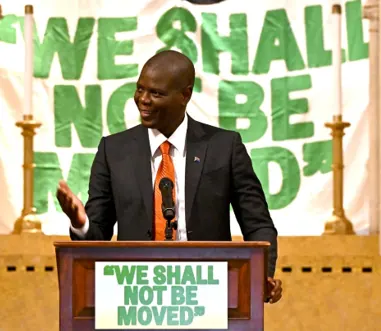
South Africa has reaffirmed its commitment to defending the principles of the United Nations Charter, international law, and multilateralism, despite the challenges associated with taking a stand on global conflicts. International Relations and Cooperation Minister Ronald Lamola made this statement while addressing a special event, “We Shall Not Be Moved: A Special Event in Honour of the UN Charter,” at The Riverside Church in New York.
Lamola cited South Africa's own liberation struggle as a demonstration of the power of international solidarity. He recalled that the country's commitment to international law was reflected in its decision to approach the International Court of Justice (ICJ) over Israel's alleged violations of the Genocide Convention. This move was part of South Africa's commitment to upholding and defending international law and multilateral institutions.
The Minister used the historic significance of The Riverside Church to frame South Africa's current position on international peace and justice. He noted that civil rights leader Martin Luther King Jr. delivered his “Beyond Vietnam” speech at the church in 1967, while former President Nelson Mandela addressed a crowd at the same venue shortly after his release from prison in 1990.
Lamola also highlighted the situation in Palestine, where Palestinians continue to face severe suffering, and Israel's actions are threatening prospects for a two-State solution. He stated that South Africa could not ignore what was happening to Palestinians and that the country would continue to advocate for international law, peace, and justice.
The Minister emphasized that South Africa's position forms part of a broader commitment to strengthening the multilateral system and the principles underpinning the UN Charter. He noted that the UN Charter's principles of fundamental human rights, the dignity and worth of every person, and the equal rights of nations are more important than ever.
Lamola acknowledged that South Africa's position has attracted questions about whether the country should instead focus on domestic socioeconomic challenges or avoid confrontation with powerful states. However, he stated that South Africa had chosen to act based on its historical experience of international solidarity and that silence in the face of grave injustice is complicity.
The Minister concluded by reaffirming South Africa's determination to continue advocating for international law, peace, and justice. He stated that countries supporting the cause are growing in number and that South Africa will not be moved in its defence of humanity.
Key points
- South Africa will continue to defend the principles of the UN Charter, international law, and multilateralism.
- The country's commitment to international law was reflected in its decision to approach the International Court of Justice (ICJ) over Israel's alleged violations of the Genocide Convention.
- Lamola emphasized that silence in the face of grave injustice is complicity.