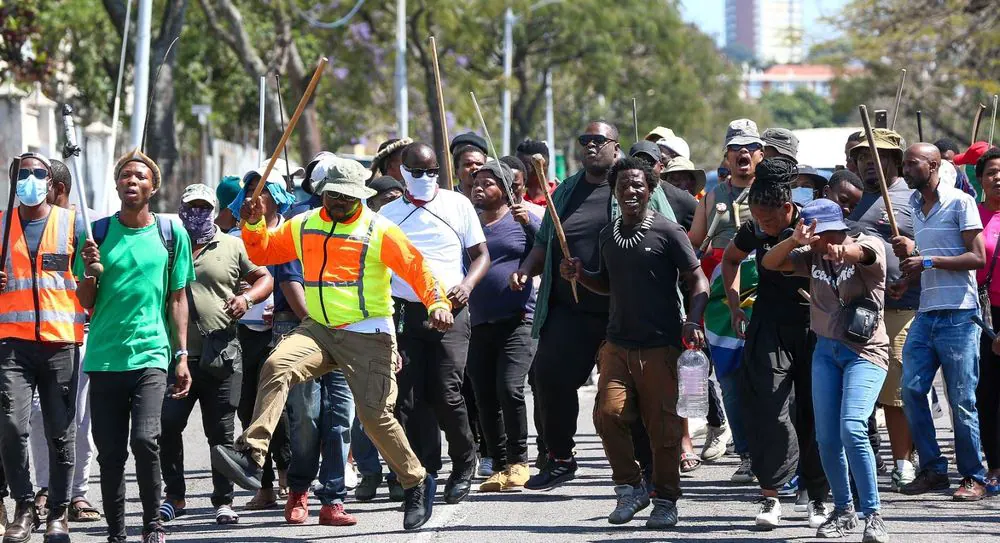
Protests broke out in Durban, South Africa, after the Department of Home Affairs withdrew a directive that allowed undocumented migrants to apply for asylum. The directive, signed by the Director-General, was issued following a Constitutional Court judgment that declared provisions of the Refugees Act creating barriers for people who entered irregularly invalid. However, the department admitted that its offices were overwhelmed within days of issuing the directive, and serious threats to public safety and order had emerged.
The protests, which began on Tuesday, saw thousands of people queueing outside the Durban centre on Che Guevara Road, after Home Affairs told them to report in person. However, the March and March anti-illegal immigration movement shut down the centre, forcibly removing individuals from lines and blocking the entrance, declaring that "no foreigners" would be allowed entry. Public Order Police were deployed, using stun grenades to manage the crowd.
The protests spread beyond Che Guevara Road, with vehicles set alight in the Durban CBD as March and March swept through shutting down businesses owned by other African nationals. Similar protests were held in Johannesburg and the Eastern Cape, with reports of vehicles being torched and foreign-owned shops looted. The protests were led by March and March founder Jacinta Ngobese-Zuma, who camped outside the office to keep it closed.
The Department of Home Affairs admitted that its offices were overwhelmed within days of issuing the directive and that serious threats to public safety and order had emerged. However, the withdrawal of the directive does not overturn the Constitutional Court ruling, which remains binding. Home Affairs now says it will embark on "a fresh process to determine the most appropriate operational approach" to comply with the ruling.
The protests have highlighted the deep-rooted frustrations of South African citizens with the country's immigration system. Many citizens have expressed concerns that the system is being exploited by economic migrants who are taking advantage of the country's generosity. The frustration from South African citizens is not xenophobia, but rather a lived reality of competing for jobs and resources with undocumented migrants.
The South African government has been criticized for its handling of the situation, with many arguing that it has failed to secure the border and protect its citizens. The government has been accused of failing to plan accordingly for the influx of migrants and of not doing enough to address the root causes of the problem. The judiciary has also been criticized for its role in the crisis, with some arguing that it has not done enough to balance the rights of asylum seekers with the rights and security of South African citizens.
The crisis has sparked a national debate about immigration and the need for a complete reset of the system. Many are calling for a secure border, a differentiation between genuine refugees and economic migrants, and a fast and fair process for asylum seekers. The government has been urged to listen to the people and to take a more nuanced approach to addressing the crisis, rather than simply relying on force and repression.
Key points
- The protests were sparked by the Department of Home Affairs' decision to withdraw a directive allowing undocumented migrants to apply for asylum.
- The protests highlighted the deep-rooted frustrations of South African citizens with the country's immigration system.
- The crisis has sparked a national debate about immigration and the need for a complete reset of the system.