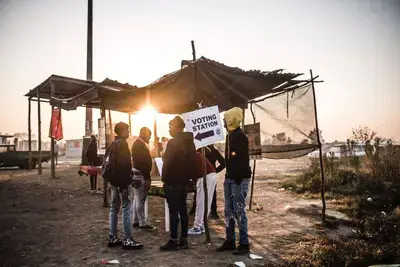
The 2026 local government elections in South Africa are set to take place on November 4, with 546 political parties and almost 137,000 candidates competing for just over 10,500 council seats. A political expert, Dr. Oscar van Heerden, has described the number of parties as a logistical nightmare for the Electoral Commission of South Africa (IEC). He believes that new legislation is needed to curb the ease with which political parties can participate in elections.
The IEC has assured that it has put systems in place to avert any vote rigging, following a two-hour leader board glitch during the 2024 polls. To prevent a repeat of the incident, the IEC is deploying an additional 14,000 voter management devices and strengthening its election systems with 40,000 gadgets already procured. This move aims to improve voting efficiency, particularly at heavily populated stations.
Voters can check their registration status and find their voting station by SMSing their identity number to 32810 or using the voting station finder on the IEC's website. The IEC is also preparing to accommodate voters who cannot cast their ballots on election day due to illness, work, or old age. A total of 2.6 million special votes have been approved, with over 600,000 home visits scheduled for Monday and Tuesday.
To ensure information integrity, the IEC has entered a multi-stakeholder partnership with leading civil society organizations and online platforms, including Meta Inc., Google, TikTok, and Microsoft. The partnership aims to mitigate the dissemination of disinformation during the election period. The IEC has also promulgated an additional Code of Conduct on measures to counter disinformation.
Contesting political parties have signed the Electoral Code of Conduct, promoting free, fair, and peaceful campaigning. The code sets standards for responsible participation in the elections. A total of 109 domestic observer organizations have been accredited to strengthen transparency, accountability, and credibility of the electoral process.
The IEC has briefed accredited observer organizations and foreign diplomats based in South Africa on key electoral milestones, election processes, and the IEC's state of readiness to deliver the 2026 local government elections. Voters will receive two ballots: one for a person to represent their local geographic ward and the second for a party to be in charge of their municipality.
The determination of local council seats in a municipality is based on a quota of votes needed to gain a seat. The quota is worked out by adding the total number of votes cast in that election on both the PR and ward ballots and then dividing it by the number of seats available in the municipality. Municipal councils serve a five-year term, and there are three types of municipal councils operating at metropolitan, local, and district levels.
Key points
- The IEC has deployed additional voter management devices and strengthened its election systems to prevent a repeat of the 2024 leader board glitch.
- A total of 546 political parties and almost 137,000 candidates are competing for just over 10,500 council seats.
- The IEC has entered a multi-stakeholder partnership with leading civil society organizations and online platforms to mitigate the dissemination of disinformation.